Fertilizer compatibility explained
Most gardeners assume that if one fertilizer is good, two must be better. It’s a natural instinct, especially when your leafy friends are struggling and you want to throw everything at the problem. But mixing fertilizers without checking compatibility can actually work against you, causing nutrient lockup, equipment damage, or worse, harming the very plants you’re trying to nurture. Proper compatibility can boost fertilization efficiency by up to 25%, which means getting this right isn’t just about avoiding disasters. It’s about getting more from every drop you apply. This guide breaks it all down so you can mix with confidence.
Table of Contents
- What is fertilizer compatibility and why does it matter?
- Key types of fertilizers and common compatibility issues
- How to test fertilizer compatibility at home (the jar test)
- Practical tips for integrating and applying compatible fertilizers
- The truth about fertilizer compatibility: What most gardeners miss
- Take your garden to the next level with smart fertilization
- Frequently asked questions
Key Takeaways
| Point | Details |
|---|---|
| Always check compatibility | Mixing the wrong fertilizers can harm your plants and waste money. |
| Jar test is simple and effective | Test your blends at home to spot problems before you spray or pour. |
| Safe combinations boost results | Compatible mixes deliver nutrients efficiently and support healthier growth. |
| Soil tests inform choices | A soil test guides what your plants truly need and prevents mistakes. |
What is fertilizer compatibility and why does it matter?
Fertilizer compatibility refers to the ability of two or more fertilizers to be mixed together without causing unwanted chemical or physical reactions. When fertilizers are compatible, they blend smoothly, stay stable in solution, and deliver nutrients effectively to your plants. When they’re not, things get messy fast.
The risks of incompatible mixing are real and surprisingly common. Here’s what can go wrong:
- Precipitation: Certain fertilizer combinations react and form solid particles that settle out of solution, blocking sprayer nozzles and reducing nutrient delivery.
- Nutrient lockup: Some ions bind together and become unavailable to plants, meaning your garden misses out on the nutrition you thought you were providing.
- Equipment damage: Clogged irrigation lines, gunked-up sprayers, and corroded tanks are all downstream effects of incompatible blends.
- Reduced efficiency: Even without visible problems, an incompatible mix can quietly underperform, leaving your plants undernourished.
One of the most common and damaging mistakes is mixing calcium-based fertilizers with phosphorus or sulfur sources. Calcium reacts with both to form insoluble compounds that your plants simply cannot absorb. Incompatible fertilizers can tie up nutrients and damage plants in ways that aren’t always immediately visible, making it easy to misdiagnose the problem as something else entirely.
Home gardeners tend to make a few predictable errors. Mixing concentrates directly without diluting first, combining fertilizers in the same tank without testing, or trusting that “natural” or “organic” labels automatically mean safe to combine are all habits worth reconsidering.
“More fertilizer doesn’t mean more growth. The right fertilizer, applied correctly, is what your garden actually needs.”
The stakes are highest when you’re working with water-soluble fertilizers in a fertigation system, or when you’re applying to sensitive plants like seedlings or recently transplanted specimens. A bad mix at a critical growth stage can set your plants back weeks. Understanding compatibility isn’t just a technical detail. It’s one of the most nurturing things you can do for your garden ecosystem.
Key types of fertilizers and common compatibility issues
Not all fertilizers behave the same way in a mix. Understanding the basic categories helps you anticipate where problems are most likely to arise.
Inorganic fertilizers are mineral-based, fast-acting, and highly concentrated. They’re efficient but also more reactive, meaning the risk of incompatibility is higher when combining two inorganic sources. Organic fertilizers are derived from natural materials like compost, bone meal, or fish emulsion. They’re gentler and slower to release, but they’re not automatically safe to combine with everything.
Water-soluble fertilizers dissolve completely and are often used in liquid feeding or fertigation systems. Granular fertilizers are applied dry and release nutrients more slowly. Mixing granulars is generally lower risk, but liquid combinations require much more attention.
Here’s a quick-reference guide to common fertilizer pairings:
| Type A | Type B | Compatible | Caution | Risk |
|---|---|---|---|---|
| Calcium nitrate | Potassium nitrate | Yes | None | Low |
| Calcium nitrate | Phosphate fertilizers | No | Precipitation | High |
| Ammonium sulfate | Lime | No | pH spike, ammonia loss | High |
| Urea | Ammonium nitrate | Yes | Monitor pH | Low |
| Organic compost tea | Liquid kelp | Yes | None | Low |
| Iron chelate | High-pH solution | Caution | Chelate breakdown | Medium |
Some safe combinations to build on:
- Potassium nitrate with magnesium sulfate
- Calcium nitrate applied separately from phosphate sources
- Compost teas with most liquid organic supplements
Pairs to approach with caution or avoid entirely:
- Calcium sources with phosphate or sulfate fertilizers
- Ammonium-based fertilizers with alkaline materials like lime
- Iron or manganese with high-pH solutions
Even water-soluble fertilizers can be incompatible due to pH or ion issues, which is why charts alone aren’t enough. Your local water source, the pH of your soil, and even the temperature of your solution can all influence how two fertilizers interact. A combination that works perfectly for one gardener in one region might cause problems for another. That’s the part that catches even experienced growers off guard.
“Compatibility charts are a starting point, not a guarantee. Real-world variables always matter.”
How to test fertilizer compatibility at home (the jar test)
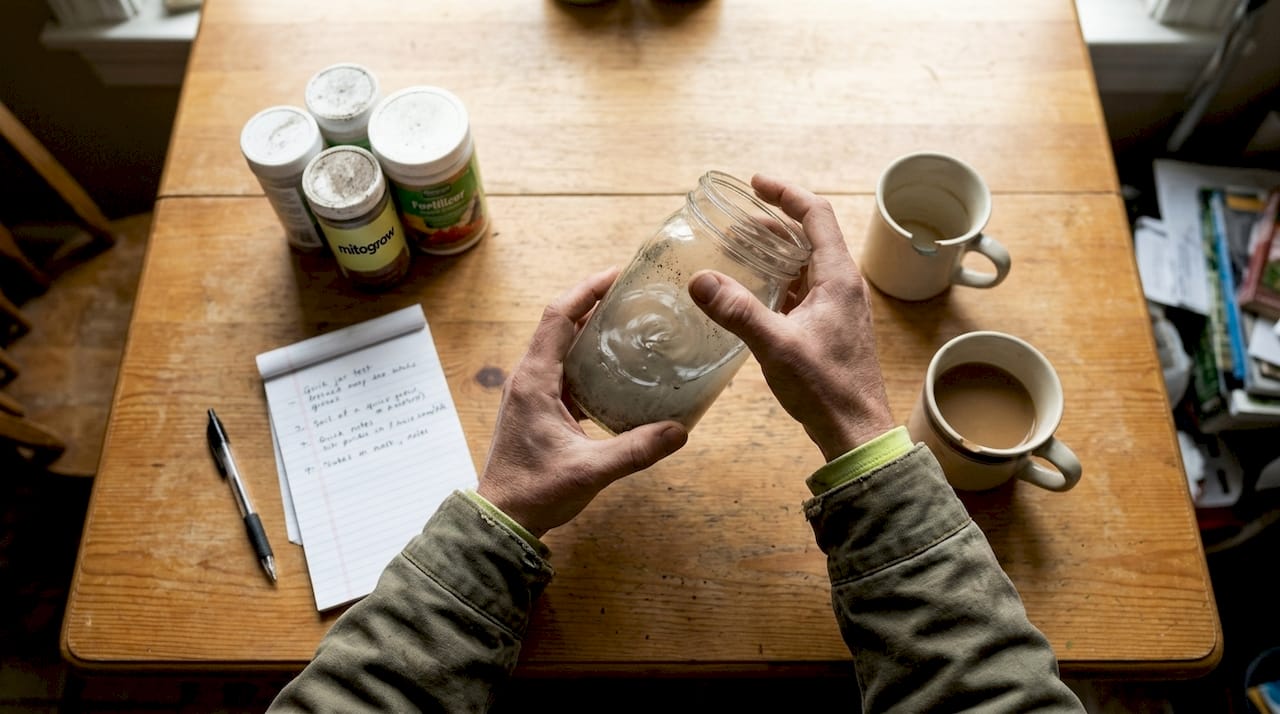
Knowing what can and can’t be mixed is useful, but real confidence comes from testing your specific fertilizer blends before using them. The jar test is simple, reliable, and something every home gardener can do with supplies already on hand.
What you’ll need:
- A clean, clear glass jar
- Measuring spoons or a small scale
- The fertilizers you plan to mix
- Clean water (ideally the same water source you use in your garden)
- A timer
Step-by-step jar test:
- Fill the jar halfway with water at room temperature.
- Add the first fertilizer at the same ratio you plan to use in your garden.
- Stir or shake gently until dissolved.
- Add the second fertilizer at its intended ratio.
- Shake the jar for 30 seconds.
- Set it aside and wait 12 to 24 hours.
- Inspect the solution carefully.
The jar test reveals compatibility by showing cloudiness, solids, or heat after mixing. Here’s how to read the results:
| Result | What it means | Action |
|---|---|---|
| Clear solution | Compatible blend | Safe to use |
| Slight cloudiness | Marginal compatibility | Use immediately, don’t store |
| Heavy cloudiness or solids | Incompatible | Do not use |
| Heat generated | Chemical reaction | Do not use |
| Color change | Possible reaction | Test further or avoid |
Pro Tip: Always jar test every new fertilizer combination, even if a compatibility chart says it should be fine. Your water source, local pH, and product formulations can all affect the outcome in ways a general chart won’t predict.
Before you even get to the jar test, it’s worth starting with a soil test guidance from your local extension service. Knowing what your soil already has means you can target what’s actually missing, rather than layering on nutrients your plants don’t need. It’s one of the most empowering steps you can take as a home gardener.
Practical tips for integrating and applying compatible fertilizers
You’ve tested your blend, so what comes next? Here’s how to get the most benefit from compatible fertilizers in your garden routine.
Start with a clear picture of your soil’s needs. For home gardeners, testing your blend beforehand and using separate tanks for hydroponics or fertigation are two of the most effective ways to prevent problems before they start. A soil test removes the guesswork and helps you apply only what’s needed.
Here are practical habits to build into your fertilization routine:
- Mix in the right order: Always add fertilizers to water, not water to fertilizer. Add one product at a time and allow it to dissolve fully before adding the next.
- Label everything: If you pre-mix solutions, label them with the date, contents, and dilution ratio. Memory is unreliable when you’re managing multiple plants.
- Store solutions carefully: Most mixed fertilizer solutions should be used within 24 hours. Don’t store them in unmarked containers or in direct sunlight.
- Use separate tanks for hydroponics: In hydroponic or fertigation systems, keep calcium-based fertilizers in a separate tank from phosphate or sulfate sources. Combine them only at the point of application.
- Introduce new blends gradually: When trying a new combination for the first time, apply to a small test area first and monitor your plants for a week before scaling up.
Organic and synthetic fertilizers can absolutely be used together, but the same rules apply. Jar test the blend, introduce it gradually, and watch your plants’ response before committing to a full application.
Pro Tip: Never reuse old fertilizer containers without rinsing them thoroughly first. Residue from a previous product can react with a new one before it even reaches your plants, creating exactly the kind of incompatibility you were trying to avoid.
Two of the most common problems that come from skipping these steps are clogged sprayers and nutrient lockout. Both are frustrating, both are preventable, and both tend to show up at the worst possible moment, right when your garden needs attention most.
The truth about fertilizer compatibility: What most gardeners miss
Here’s something the compatibility charts won’t tell you: the variables that matter most are often the ones that are hardest to standardize. Water source is a big one. Hard water with high calcium content can push a borderline-compatible mix into full precipitation territory. Tap water pH varies by region and even by season. These are things that no printed chart accounts for.
Nursery professionals with decades of experience will tell you that unexpected incompatibilities happen even with well-known product combinations. A mix that worked flawlessly last summer might behave differently in spring when water chemistry shifts. Even with charts, real-world results can differ, which is why jar testing your own blends is the only way to know for certain what’s happening in your specific conditions.
The gardeners who see the most consistent results aren’t the ones who memorize the most charts. They’re the ones who test, observe, and adjust. Simple precautions, like the jar test and a basic soil test, make the difference between a thriving garden and one that’s quietly struggling without an obvious cause. Trust the process, and your leafy friends will thank you.
Take your garden to the next level with smart fertilization
Understanding fertilizer compatibility is a game-changer, but it works best when paired with products that are designed to support your plants from the inside out. At mitogrow, you’ll find science-backed garden nutrition solutions that are compatible with any fertilizer you’re already using. mitogrow’s biostimulant formula boosts nutrient uptake by up to 50%, meaning every compatible blend you apply works harder for your plants. Whether you’re nurturing a windowsill herb garden or managing a full outdoor ecosystem, mitogrow is the kind of support your plants actually need. Explore the full product line and find the right fit for your garden.
Frequently asked questions
What happens if I mix incompatible fertilizers?
Mixing incompatible fertilizers can cause precipitation and nutrient tie-up, leading to clogged equipment, reduced plant nutrition, and in some cases, direct damage to your plants.
How can I tell if fertilizers are compatible?
Use the jar test: combine small amounts with water, shake, and check for cloudiness, solids, or heat after 12 to 24 hours. A clear solution means you’re good to go.
Is it safe to mix organic and synthetic fertilizers?
Yes, with the right precautions. Always jar test organic and synthetic blends before applying and introduce the combination gradually to monitor how your plants respond.
Why do experts recommend soil testing before fertilizing?
A soil test first tells you exactly which nutrients are already present and which are lacking, so you can fertilize with precision instead of guessing and potentially over-applying.