How to improve soil nutrient uptake for thriving gardens
You water faithfully, you fertilize on schedule, and yet your leafy friends still look tired, pale, or just plain stuck. The frustrating truth is that most plant struggles aren’t about what you’re adding to the soil. They’re about whether your plants can actually absorb it. Soil nutrient uptake, the process by which roots pull minerals and compounds from the surrounding soil, is the real engine behind a thriving garden. When that engine sputters, no amount of extra fertilizer will save your plants. This guide walks you through understanding, fixing, and maintaining the conditions your soil needs so every plant in your care can genuinely flourish.
Table of Contents
- Understanding soil nutrient uptake: The fundamentals
- What you need: Tools, amendments, and prerequisites
- Step-by-step: Improving soil nutrient uptake in your garden
- Troubleshooting and avoiding common mistakes
- Verifying success: How to measure improvement
- What most gardeners overlook about soil nutrient uptake
- Take the next step with better soil solutions
- Frequently asked questions
Key Takeaways
| Point | Details |
|---|---|
| Test soil first | A simple soil test reveals nutrient gaps and helps target your amendments. |
| Organic matter is key | Adding compost or mulch builds microbial life and unlocks more nutrients naturally. |
| Easy does it on fertilizer | Combining organic and synthetic fertilizers can increase yields without harming soil health. |
| Minimize soil disturbance | No-till methods protect beneficial fungi and boost persistent nutrient availability. |
| Monitor, adjust, repeat | Observe plant health, retest regularly, and keep improving your soil for lasting results. |
Understanding soil nutrient uptake: The fundamentals
Now that you know the problem often lies hidden below the surface, let’s see what controls nutrient absorption in the first place.
Nutrient uptake is simply the process by which plant roots capture minerals from the soil and move them into the plant’s tissue. Roots are the real absorbers here, not the leaves, not the stem. Everything starts underground. And the way roots actually grab nutrients happens through three main pathways:
- Root interception: Roots physically grow into contact with nutrient particles in the soil.
- Diffusion: Nutrients like phosphorus and potassium move slowly from areas of high concentration toward the root surface.
- Mass flow: Water carries mobile nutrients like nitrate, calcium, and magnesium directly to the root zone as the plant drinks.
As nutrient uptake research confirms, all three processes are strongly influenced by soil pH. The sweet spot for most vegetables and flowering plants sits between 6.2 and 6.8. Inside that range, nutrients dissolve readily and roots can access them. Outside of it, especially above 7.5, micronutrients like zinc, copper, manganese, and iron get chemically locked up in the soil, invisible to roots no matter how much you’ve added.
Common signs that your soil’s uptake is struggling include:
- Yellowing leaves (especially between the veins, a classic sign of iron or manganese deficiency)
- Slow, stunted growth even in warm weather
- Poor flowering or fruit set despite regular feeding
- Pale, washed-out color on new growth
“The most common gardening mistake isn’t under-fertilizing. It’s fertilizing without knowing whether the soil can actually deliver those nutrients to the plant.”
Pro Tip: Before you buy a single bag of fertilizer or amendment, get a soil test. Your local cooperative extension office often offers them affordably, and the results will tell you exactly what your soil is missing and what it already has plenty of.
What you need: Tools, amendments, and prerequisites
Once you understand how nutrients move, you’ll need the right tools and amendments to address what your soil actually needs.
Think of this as your soil care toolkit. Each item has a specific job, and using the right one at the right time makes all the difference.
| Amendment | What it does | When to use it |
|---|---|---|
| Compost | Boosts organic matter, water retention, and microbial life | Every season, as a top dressing or soil mix |
| Lime | Raises soil pH in acidic soils | When pH is below 6.0 |
| Sulfur | Lowers soil pH in alkaline soils | When pH is above 7.0 |
| Balanced fertilizer | Supplies N-P-K directly | During active growing season |
| Mycorrhizal inoculant | Extends root reach for phosphorus and water | At transplanting or seeding |
| Mulch | Regulates moisture and temperature, feeds soil biology | Year-round, 2-3 inches deep |
| Soil test kit | Identifies pH and nutrient gaps | Before any amendment program |
As organic matter research shows, adding compost consistently increases soil organic matter, water-holding capacity, and nutrient bioavailability. That means your fertilizer dollars go further when compost is part of the picture.
Here’s what to prioritize before you start amending:
- Get a soil test first. This is non-negotiable. Skipping pH correction and going straight to fertilizer is one of the most common and costly mistakes gardeners make.
- Know your soil type. Sandy soils drain fast and need more frequent organic matter additions. Heavy clay soils need structure improvement before nutrients can move freely.
- Source quality compost. Bagged compost works, but homemade compost is richer and more diverse in microbial life.
Pro Tip: Start a compost pile today, even a small one. Kitchen scraps, dried leaves, and garden trimmings break down into one of the most powerful soil amendments available, and it costs almost nothing.

Step-by-step: Improving soil nutrient uptake in your garden
With your tools ready and amendments on hand, it’s time to follow a proven process to boost uptake, step by step.
- Test your soil. Use a home kit or send a sample to your local extension lab. Note your pH, organic matter percentage, and any flagged deficiencies.
- Adjust pH first. Add lime to raise pH or sulfur to lower it. Work it into the top 6 inches and retest after 4 to 6 weeks.
- Add organic matter. Spread 2 to 3 inches of compost over your beds and work it into the top layer. Do this every season.
- Minimize tillage. No-till and reduced-till methods preserve fungal networks, increase soil organic carbon, and raise available nutrient levels compared to conventional digging.
- Apply mulch or plant cover crops. Mulch protects soil biology and feeds it slowly. Cover crops like clover or rye add nitrogen and organic matter between growing seasons.
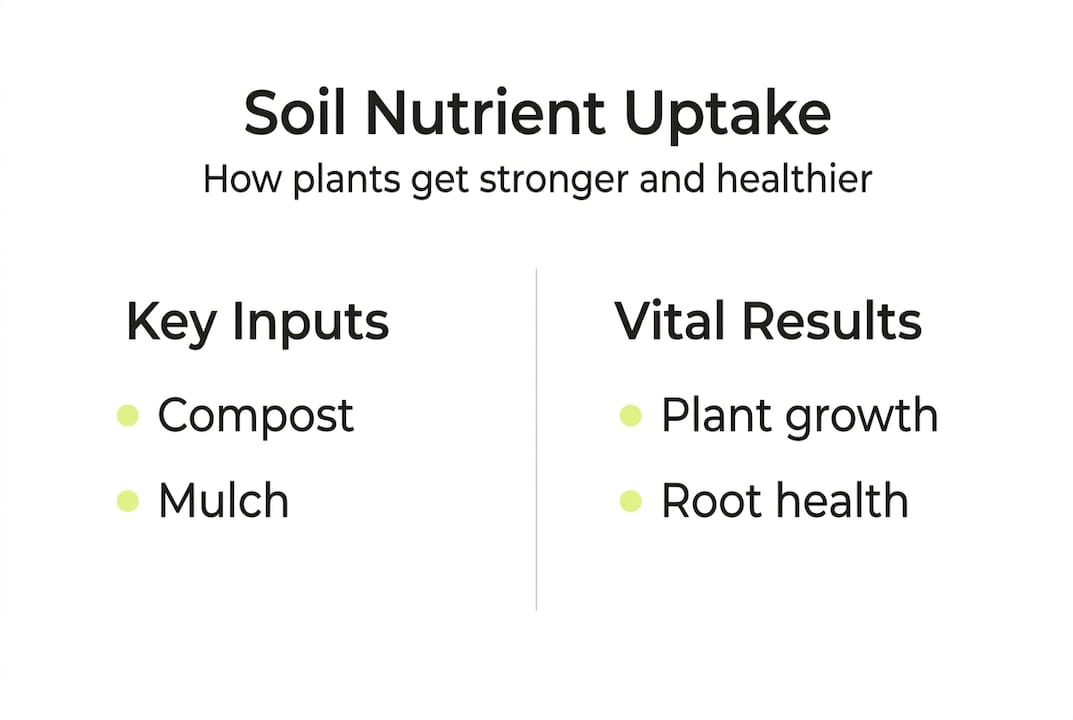
- Introduce mycorrhizal fungi. These beneficial fungi can boost phosphorus uptake up to 10-fold in garden settings. Apply inoculants at transplanting by dusting roots or mixing into the planting hole.
- Fertilize strategically. Split applications into smaller, more frequent doses rather than one heavy feeding. Combining organic and synthetic fertilizers gives you both immediate availability and long-term soil building.
| Approach | Nutrient availability | Soil health impact | Best for |
|---|---|---|---|
| No-till | Higher long-term | Excellent | Established beds |
| Conventional till | Short-term boost | Disrupts fungi | New beds only |
| Organic amendments | Slow release | Builds structure | Long-term gardens |
| Synthetic fertilizer | Fast release | Neutral to negative | Quick corrections |
Important: Never skip the soil test before adding amendments. Adding lime to already-alkaline soil, or phosphorus to already-saturated soil, can lock out other nutrients and make plant health worse, not better.
Troubleshooting and avoiding common mistakes
Even a smart plan can go wrong if you miss these common traps or ignore edge cases that apply to some crops and soil types.
Here are the mistakes that quietly undermine even the most well-intentioned garden care routines:
- Over-fertilizing. More is not more. Excess nitrogen causes lush, weak growth and can burn roots, while excess phosphorus suppresses the beneficial fungi your plants rely on.
- Ignoring pH. You can add every amendment in the catalog and still see zero improvement if your pH is off. Nutrients simply won’t dissolve at the wrong pH.
- Destroying soil structure. Frequent deep tilling breaks apart fungal networks and compacts soil over time, reducing the very pathways nutrients travel through.
- Watering errors. Overwatering pushes oxygen out of the soil, suffocating roots and the microbes that help deliver nutrients. Underwatering reduces mass flow, cutting off nutrient delivery.
As plant stress research highlights, soil tests are the most reliable way to identify deficiencies, and slow-release fertilizers paired with consistent moisture management help stressed plants recover without the risk of further damage.
A few edge cases worth knowing: brassicas (cabbage, broccoli, kale) and beets do not form relationships with mycorrhizal fungi, so inoculants won’t help those crops. And as mycorrhizal research notes, high-phosphate fertilizers can suppress fungal colonization even in plants that would otherwise benefit.
“Don’t skip the soil test. Adding the wrong product can worsen issues, not solve them.”
Pro Tip: For stressed or struggling plants, use a fast-acting synthetic fix to stabilize them while you build long-term soil health with organic matter and biology. Think of it as triage followed by rehabilitation.
Verifying success: How to measure improvement
After you implement these strategies, it’s time to see if your soil and your plants are actually responding.
Improvement in soil nutrient uptake doesn’t always show up overnight, but there are clear signals to watch for:
- Leaf color: Healthy, deep green leaves replacing pale or yellowed ones is one of the first visible signs.
- Growth rate: Plants that were stuck suddenly push new leaves, stems, or roots with more energy.
- Root vigor: When you transplant or divide plants, look for dense, white, healthy roots rather than sparse or brown ones.
- Yield and bloom: More flowers, larger fruit, and better harvests are the ultimate proof that nutrients are getting through.
Keep a simple garden journal. Note what you applied, when, and what you observed. Retest your soil every one to two years to track organic matter levels, pH shifts, and nutrient balance. This habit turns guesswork into a real feedback loop.
The numbers can be striking. Research on fertilizer combinations shows that partially substituting synthetic fertilizer with 30% organic fertilizer can increase yield by 1 to 251% and improve overall soil quality by 31 to 336%, depending on the crop and baseline conditions. That’s a wide range, but even the lower end represents meaningful progress for a home garden.
Remember that microbial life and soil structure take time to rebuild. Give your improvements at least one full growing season before drawing conclusions. The underground ecosystem is quietly thriving even when surface changes feel slow.
What most gardeners overlook about soil nutrient uptake
Most guides focus on what to add to your soil. Rarely do they talk about what to stop doing.
The gardening industry is full of products promising fast results, and it’s tempting to reach for the next bottle when your plants are struggling. But the honest truth is that no single product can fix poor soil structure or a depleted microbial community. Those things take time, consistency, and a willingness to work with the soil rather than against it.
The gardeners who see the most lasting improvement are the ones who commit to minimal disturbance, keep living roots in the ground as long as possible, and feed their soil with organic matter season after season. These aren’t glamorous practices. They don’t make for exciting social media posts. But they’re what actually builds the kind of rich, biologically active soil where nutrient uptake happens almost effortlessly.
Think of your garden’s underground world as a slow-growing community. The fungi, bacteria, and other microbes that support your plants need stability and food to thrive. Every time you till deeply or drench with synthetic inputs, you’re disrupting that community. Every time you add compost or leave mulch in place, you’re nurturing it.
Patience is the most underrated tool in any gardener’s kit. Measure your progress in seasons, not days, and you’ll be amazed at what your soil becomes.
Take the next step with better soil solutions
You now have a clear, research-backed path to healthier soil and stronger plants. The next step is making sure your plants have the cellular support to actually use what you’re giving them. mitogrow’s biostimulant formulas are designed to work alongside your soil-building efforts, helping plants absorb nutrients more efficiently from within. Whether you’re nurturing a container garden, reviving a struggling shrub, or building a thriving outdoor bed, exploring plant growth products at mitogrow.com can give your garden the extra edge it deserves. Because your plants have worked hard enough. Now it’s time to help them work smarter.
Frequently asked questions
How do I know if my soil has poor nutrient uptake?
Plants may show yellowing, slow growth, or poor yields despite regular fertilization. A soil test confirms deficiencies and points you toward the right fix.
Can I improve nutrient uptake without chemical fertilizers?
Absolutely. Increasing organic matter through compost and mulch, along with adding mycorrhizal fungi, improves uptake naturally. Compost enhances nutrient bioavailability and feeds the microbial life that makes nutrients accessible.
Are all vegetables helped by mycorrhizal fungi?
Most are, but brassicas and beets are exceptions. Brassicas and beets don’t benefit from mycorrhizal inoculants, and high-phosphorus fertilizer can suppress fungal activity even in crops that would otherwise respond well.
How often should I retest my garden soil?
Retest every one to two years, or sooner if you notice persistent plant problems. Regular retesting keeps amendments balanced and prevents over-correction.
Does no-till gardening really improve nutrient uptake?
Yes. No-till increases organic carbon and preserves fungal networks that are critical for nutrient delivery, leading to measurably higher available nutrients over time.