Plant growth regulators: Boost your home garden success
Most home gardeners trust the classic trio: sunlight, water, and good soil. And honestly, that trio does a lot of heavy lifting. But even a perfectly watered, well-lit plant can underperform if its internal chemistry isn’t firing on all cylinders. Plant growth regulators, or PGRs, are the behind-the-scenes players that shape how your leafy friends germinate, root, flower, and handle stress. Understanding them doesn’t require a science degree. It just requires a little curiosity and the willingness to look beyond the basics.
Table of Contents
- What are plant growth regulators?
- The main types of plant growth regulators
- How plant growth regulators improve plant health and yield
- Practical steps for using plant growth regulators safely
- Enhance your garden with innovative biostimulants
- Frequently asked questions
Key Takeaways
| Point | Details |
|---|---|
| PGRs impact plant growth | Plant growth regulators can dramatically shape rooting, flowering, and yield in home gardens. |
| Understand PGR types | Auxins, gibberellins, cytokinins, abscisic acid, and ethylene each serve unique roles in plant development. |
| Safe application matters | Proper dosing, timing, and plant health checks prevent problems like stunting or deformities. |
| Biostimulants offer alternatives | Biostimulants are sustainable options but usually less potent in effect compared to synthetic PGRs. |
| Results depend on variables | Species, growth stage, and environment influence how plants respond to growth regulators. |
What are plant growth regulators?
Let’s clear up a common mix-up first. Fertilizers feed your plants from the outside, pushing nutrients into the soil. Biostimulants work from within, supporting how plants process and use what’s already available. PGRs are a distinct category: plant growth regulators are natural or synthetic chemicals that mimic or alter plant hormones to influence growth, development, flowering, rooting, and stress responses.
Think of PGRs as the messaging system inside your plant. They don’t add energy or nutrients directly. Instead, they send signals to cells, telling them when to divide, stretch, slow down, or wake up. These signals travel through specific receptors and pathways, almost like a text message that triggers a chain reaction. The result? Visible changes in how your plant grows, blooms, or survives tough conditions.
Here’s what PGRs can influence in your garden:
- Germination: Triggering seeds to sprout at the right time
- Root development: Encouraging stronger, deeper root systems
- Flowering and fruit set: Timing blooms and improving fruit production
- Dormancy: Helping plants rest or wake up on cue
- Stress responses: Supporting plants through heat, drought, or transplant shock
One thing worth knowing: correct PGR usage has been linked to up to a 20% yield increase across various crops. That’s not a small number for a home gardener hoping to get more tomatoes or bigger blooms out of the same patch of soil.
The main types of plant growth regulators
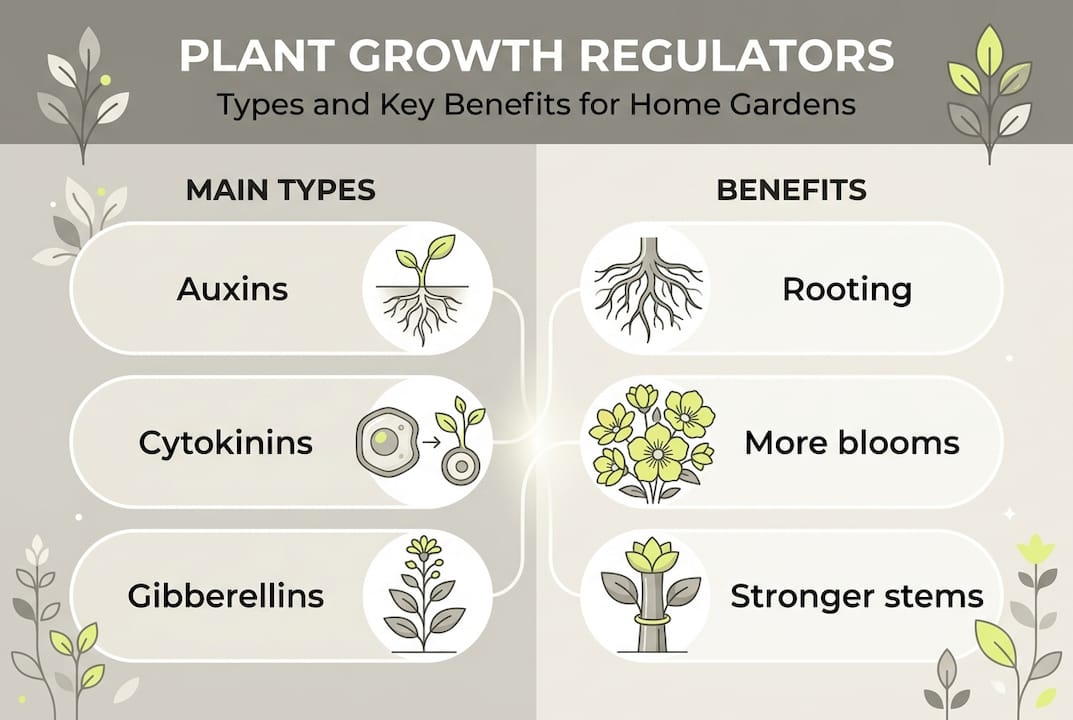
Not all PGRs do the same job. Each class targets a different part of the plant’s life cycle, and knowing which one does what helps you make smarter choices for your garden. The five main PGR classes are auxins, gibberellins, cytokinins, abscisic acid, and ethylene, each with a distinct role.
| PGR class | Primary effect | Common home garden use |
|---|---|---|
| Auxins | Cell elongation, rooting, apical dominance | Rooting cuttings, promoting root growth |
| Gibberellins | Cell division and elongation, dormancy breaking | Increasing fruit size, breaking seed dormancy |
| Cytokinins | Cell division, delays aging, bud formation | Encouraging bushier growth, delaying leaf yellowing |
| Abscisic acid (ABA) | Dormancy, stress response, stomata closure | Helping plants conserve water during drought |
| Ethylene | Fruit ripening, leaf drop, senescence | Controlling ripening in fruit crops |
Beyond these five, newer research highlights brassinosteroids and jasmonates as emerging players in stress tolerance and immune responses. But for most home gardeners, the big five are where the action is.
Here’s a quick breakdown of how each class shows up in real gardening scenarios:
- Auxins are the go-to for rooting cuttings. Rooting powder? That’s usually an auxin called IBA (indole-3-butyric acid).
- Gibberellins can break dormancy in seeds that just won’t sprout, and they’re used commercially to increase grape and apple size.
- Cytokinins delay the yellowing of leaves and encourage lateral bud growth, which means fuller, bushier plants.
- ABA is your plant’s natural stress hormone. It tells stomata (the tiny pores on leaves) to close when water is scarce.
- Ethylene is why putting a ripe banana next to green tomatoes actually works. It’s a gas that speeds up ripening.
Each class interacts with the others, too. Auxins and cytokinins, for example, work in balance to determine whether a plant grows taller or bushier. It’s a dynamic system, not a set of isolated switches.
How plant growth regulators improve plant health and yield
The science behind PGRs isn’t just theoretical. Real-world studies show measurable improvements across a wide range of crops, and the numbers are genuinely exciting for anyone who wants more from their garden.
A meta-analysis of 48 studies found that GA3 (a gibberellin) and cytokinins significantly increase fruit set, berry size, and overall yield in blueberries. In apple orchards, combining BA (a cytokinin) with NAA (an auxin) boosts cell expansion and final fruit size. Even in alfalfa, applying DPC at 0.35g/L increased seed yield to 329 kg/ha, a meaningful jump for growers.
| Crop | PGR used | Reported benefit |
|---|---|---|
| Blueberries | GA3 + cytokinins | Larger berries, higher fruit set |
| Apples | BA + NAA | Increased cell expansion, better yield |
| Alfalfa | DPC at 0.35g/L | Seed yield up to 329 kg/ha |
| Grapes | Gibberellins | Larger, seedless fruit clusters |
“PGRs can boost yields by up to 20% but must be used carefully, with attention to concentration, timing, and plant stage.”
For home gardeners, this translates to practical wins: more blooms on your roses, bigger tomatoes, cuttings that root faster, and houseplants that stay green longer. The key is matching the right PGR to the right goal at the right time.
Pro Tip: Always start with the lowest recommended concentration. More is not better with PGRs. A small, well-timed dose often outperforms a heavy application, and it protects your plants from unintended side effects.
Ornamental plants benefit too. Cytokinins applied to potted plants can delay the natural aging process, keeping foliage vibrant weeks longer than untreated plants. For anyone who’s watched a beautiful houseplant slowly yellow despite perfect care, that’s a genuinely useful tool.
Practical steps for using plant growth regulators safely
Knowing the benefits is just the start. Using PGRs well in your own garden comes down to a few clear principles: start small, time it right, and pay attention to what your plants are telling you.
Here’s a step-by-step approach to getting started:
- Identify your goal. Are you trying to root cuttings, break dormancy, boost flowering, or manage stress? Each goal points to a different PGR class.
- Choose the right product. Look for products labeled with the specific active ingredient (IBA for rooting, GA3 for dormancy, etc.) and follow the label instructions closely.
- Test on a small area first. Before treating your whole garden, apply to a few plants or a single section. Watch for 7 to 14 days before scaling up.
- Mix at the recommended concentration. Overuse causes stunting, deformities, and phytotoxicity (chemical damage to plant tissue). Dilution matters.
- Time your application carefully. Apply during active growth stages, not when plants are stressed, dormant, or in extreme heat.
- Document what you do. Note the product, concentration, date, and plant response. This makes it easy to repeat successes and avoid repeating mistakes.
Common mistakes to avoid:
- Overusing PGRs, which can cause twisted leaves, stunted growth, or even plant death
- Applying during heat waves, when plants are already under stress and more vulnerable to chemical sensitivity
- Using the wrong PGR for the growth stage, like applying a rooting hormone to a plant that’s already flowering
- Skipping the patch test, especially with new products or unfamiliar plant species
- Ignoring species differences, since what works beautifully on tomatoes may not suit your ferns
Pro Tip: Keep a simple garden journal. Even a few notes per application, like date, product, dilution, and plant response, can reveal patterns that help you fine-tune your approach over a single growing season.
One more thing worth considering: the natural versus synthetic debate. Synthetic PGRs tend to be more potent and consistent, but they can leave residues and raise sustainability questions. Natural or biologically derived options are generally gentler and more aligned with organic gardening values, though they may require more frequent application. For most home gardeners, safe PGR usage means leaning toward lower-risk, naturally derived options whenever possible, especially for edible crops.
Enhance your garden with innovative biostimulants
If PGRs have sparked your curiosity about working with your plants at a deeper level, biostimulants are a natural next step. They support the same internal processes that PGRs influence, but in a gentler, more holistic way. Innovative biostimulants like those from mitogrow are designed to activate your plant’s own cellular energy systems, boosting nutrient uptake by up to 50% and improving resilience across the full plant lifecycle. Whether you’re nurturing a new cutting, reviving a struggling houseplant, or pushing your outdoor garden to its full potential, mitogrow offers formulas built for every scenario: Trees and Shrubs, Pots and Planters, and Blooms and Beds. It’s pet-safe, impossible to overdose, and compatible with any fertilizer you’re already using. For gardeners who want science-backed support without the complexity, it’s a genuinely exciting tool to have in your kit.
Frequently asked questions
Can home gardeners use plant growth regulators safely?
Yes, home gardeners can use PGRs safely by following recommended concentrations, testing on small areas first, and avoiding application on stressed or heat-affected plants. Overuse causes stunting and phytotoxicity, so starting with the lowest effective dose is always the right move.
What are the most useful PGRs for rooting and flowering in home gardens?
Auxins, particularly IBA, are the most effective for rooting cuttings, while gibberellins support flowering, dormancy breaking, and fruit development in a wide range of home garden plants.
Do plant growth regulators work on all plants the same way?
No. The response to PGRs varies by species, growth stage, and environmental conditions, which is why patch testing and careful observation are essential before treating your whole garden.
How do biostimulants compare to synthetic PGRs?
Biostimulants are generally preferred for sustainability and are safer for edible crops, though they may be less immediately potent than synthetic PGRs. Research on biostimulant yield benefits continues to grow, with many studies showing meaningful improvements in plant health and productivity.