Soil health secrets
Most gardeners think about what they feed their plants. Very few think about what feeds the soil. That gap in thinking is exactly why so many gardens underperform, even when gardeners are doing everything else right. Soil health drives roughly 12% of global crop yield variation, yet the way we manage soil accounts for up to 70% of that outcome. In other words, the dirt beneath your feet is not passive. It is alive, dynamic, and more influential than most of us realize.
Table of Contents
- Understanding soil health: A living ecosystem
- The pillars of healthy soil: Key principles for gardeners
- Indicators of soil health: How to assess your soil
- Comparing soil health frameworks and benchmarks
- Easy improvements: Practical steps for home gardens
- Biostimulants: Innovative boosters for soil vitality
- Explore advanced solutions for soil health
- Frequently asked questions
Understanding soil health: A living ecosystem
So what exactly is soil health? It is not just about nutrients or pH levels. According to the USDA NRCS, soil health is “the continued capacity of soil to function as a vital living ecosystem that sustains plants, animals, and humans.” That definition matters because it reframes how we think about the ground beneath our gardens.
Healthy soil is not just a growing medium. It is a thriving community of bacteria, fungi, earthworms, and organic matter all working together. When that community is balanced, plants can access water and nutrients more efficiently, resist disease more naturally, and grow with less intervention from us.
Healthy soil performs five core functions that every gardener benefits from:
- Regulates water by absorbing rainfall and reducing runoff
- Sustains plant life by cycling nutrients back into available forms
- Filters and buffers pollutants before they reach groundwater
- Supports biodiversity above and below the surface
- Cycles carbon and nitrogen to keep the ecosystem in balance
“Think of your garden soil as a living city underground. Every organism has a role, and when the ecosystem thrives, your plants thrive too.”
Once you see soil this way, every gardening decision starts to look a little different.
The pillars of healthy soil: Key principles for gardeners
Now that we understand what soil health is, how can home gardeners actually enhance it? The USDA outlines four core principles that form the foundation of any soil health strategy. These are not complicated. They are practical, and they work.
- Minimize disturbance. Tilling breaks up fungal networks and disrupts soil structure. Reducing how often you dig or turn your soil preserves the microbial communities that make nutrients available to your plants.
- Keep living roots in the ground. Roots feed soil microbes through a process called exudation, releasing sugars and compounds that keep the underground ecosystem active. Bare soil between seasons is a missed opportunity.
- Cover the soil surface. Mulch, cover crops, or even fallen leaves protect soil from erosion, regulate temperature, and slowly add organic matter as they break down.
- Maximize plant diversity. Different plants attract different microbes and insects. A diverse garden is a resilient garden, less vulnerable to pest pressure and nutrient depletion.
Pro Tip: If you are new to no-till gardening, start by simply layering 2 to 3 inches of compost on top of your beds each season instead of digging it in. The worms and microbes will do the mixing for you.
Indicators of soil health: How to assess your soil
Understanding principles is essential, but how do you actually know if your soil is healthy? Soil health assessment looks at three categories of indicators.
Physical indicators include how well your soil holds its structure, how quickly water moves through it, and whether it clumps into stable aggregates or falls apart. Aggregate stability and infiltration rate are two of the most telling physical signs.

Chemical indicators cover pH, nutrient levels, and organic matter content. Optimal benchmarks for most garden soils include organic matter between 3 and 5%, and a pH range of 6.0 to 7.5. Outside those ranges, nutrient availability drops even when nutrients are present.
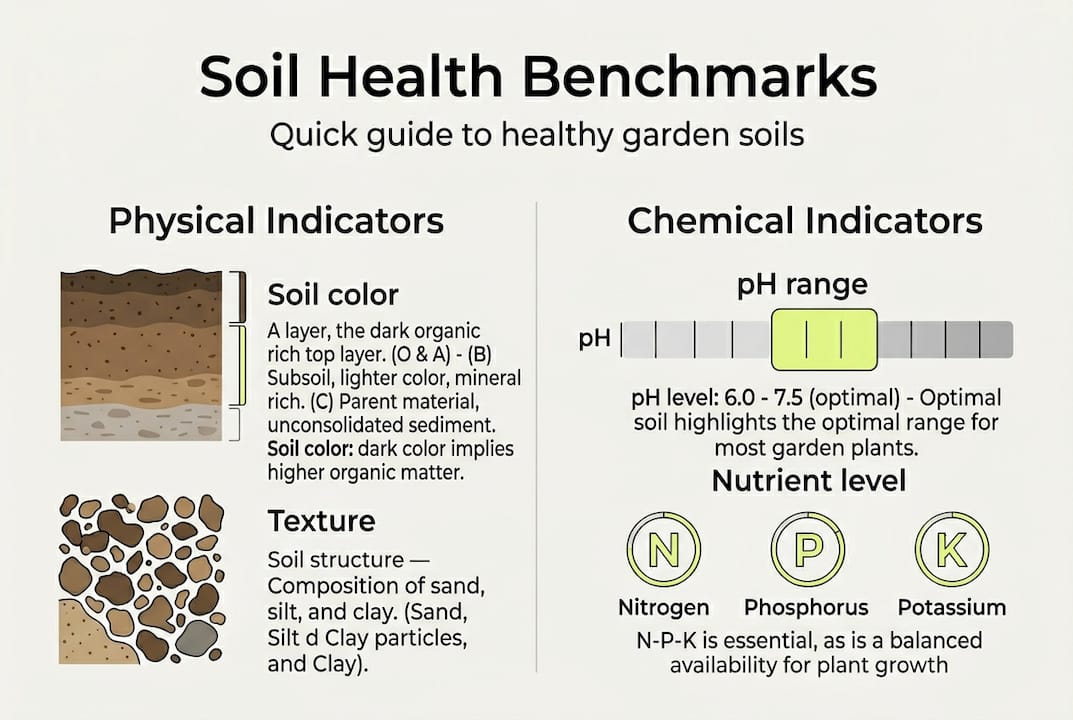
Biological indicators are often the most overlooked. Earthworm counts, microbial activity, and visible root health all signal how alive your soil really is.
Here is a quick reference for what healthy soil looks and feels like:
| Indicator | Healthy soil | Struggling soil |
|---|---|---|
| Color | Dark brown to black | Pale, gray, or reddish |
| Texture | Crumbly, loose | Compacted, clumpy, or dusty |
| Smell | Earthy, fresh | Sour, sulfurous, or odorless |
| Earthworms | Several per shovelful | Rare or absent |
| Water absorption | Soaks in quickly | Pools or runs off |
A simple home test: dig a small hole, fill it with water, and time how long it takes to drain. Healthy soil drains a few inches per hour. If it sits for hours, compaction or poor structure is likely the issue.
Comparing soil health frameworks and benchmarks
Having seen how to assess your soil, it helps to understand that not all soil health frameworks are created equal. Two widely used systems are the Soil Management Assessment Framework (SMAF) and the Comprehensive Assessment of Soil Health (CASH). Both evaluate physical, chemical, and biological indicators, but they differ in sensitivity and how they weight different factors.
One important nuance: definitions of soil health versus soil quality versus soil function are still debated among scientists. Organic matter, for example, is often cited as a universal benchmark, but its role as a stable carbon store is more complex than it first appears.
For home gardeners, the practical takeaway is this: benchmarks are context-dependent. Pasture soils often outperform forest soils as agricultural reference points, and what counts as “healthy” varies by region, climate, and soil type. Tools like smart agriculture platforms are making it easier to track these variables over time, even for home growers.
The best approach is to use benchmarks as a starting point, not a rigid standard. Track your own soil over time and look for improvement trends rather than chasing a single perfect number.
Easy improvements: Practical steps for home gardens
Once you understand your soil type and health, here is how to improve it quickly and sustainably. These steps are low-cost, low-effort, and backed by solid evidence.
- Add organic matter every year. Adding 2 to 3 inches of compost or aged organic matter annually is one of the single most effective things you can do for your garden.
- Mulch generously. A 2 to 3 inch layer of wood chips, straw, or shredded leaves keeps moisture in, regulates soil temperature, and feeds soil life as it breaks down.
- Go no-dig. No-dig gardening and compost teas are among the most accessible methods for home gardeners to protect soil structure without expensive equipment.
- Rotate your crops. Moving plant families around each season reduces pest buildup and prevents nutrient depletion in any one spot.
- Plant cover crops. Clover, vetch, and winter rye are easy options that protect bare soil, fix nitrogen, and add organic matter when turned under or cut back in spring.
Pro Tip: Compost tea, made by steeping finished compost in water for 24 to 48 hours, is a fast way to introduce beneficial microbes directly to your soil or plant roots. It is especially useful after any soil disturbance.
Biostimulants: Innovative boosters for soil vitality
Beyond traditional methods, biostimulants present some of the most exciting innovations in soil and plant vitality. These are not fertilizers. They are naturally derived compounds and microbial preparations that help plants and soil work more efficiently.
Biostimulants improve nutrient uptake, stimulate root growth, and increase stress tolerance by activating beneficial microbial communities in the soil. They work alongside whatever nutrients are already present, helping plants access what they could not reach before.
Here is what biostimulants can do for your garden:
- Improve soil structure by encouraging fungal networks and microbial diversity
- Boost nutrient efficiency so plants get more from less fertilizer input
- Increase stress resilience during drought, transplanting, or temperature swings
- Support root development for stronger, more established plants
Sustainable practices including biostimulants and carbon-rich biological fertilizers have shown measurable increases in soil organic carbon, particularly in loamy and drier soils where organic matter is hardest to build. A carbon-to-nitrogen ratio of 10 to 30 appears to be the sweet spot for maximizing those gains.
For home gardeners, the practical approach is to look for biostimulants that combine microbial inoculants with humic or fulvic acids. These formulas tend to deliver the broadest benefits across different soil types and plant varieties. Apply them at planting, during transplanting, and whenever your plants are under stress.
Explore advanced solutions for soil health
You now have a solid foundation for understanding and improving your garden’s soil health. But knowing the principles is just the beginning. If you are ready to take your garden from surviving to genuinely thriving, soil health solutions from mitogrow are worth exploring. mitogrow’s biostimulant formulas are designed to work at the cellular level, boosting nutrient uptake by up to 50% and supporting plants through every stage of their lifecycle. Whether you are nursing a struggling bed back to life or setting up a new planting for long-term success, mitogrow gives your soil and your plants the support they need to do more with what they already have.
Frequently asked questions
What is the simplest way to test soil health at home?
Dig a small handful of soil and check for earthworms, notice whether it smells earthy and fresh, and see if it crumbles easily in your hand. Healthy soil is dark, crumbly, and carries that distinctive earthy scent that signals active microbial life.
Can biostimulants help if my soil is very poor?
Yes. Biostimulants enhance nutrient uptake, root development, and microbial activity even in degraded soils, making them a strong starting point for recovery. They work best when combined with organic matter additions and reduced soil disturbance.
How often should I add organic matter or compost to my garden?
Add 2 to 3 inches of organic matter or compost annually to maintain and build soil health over time. Consistent annual additions compound in benefit, building richer, more productive soil each season.
What is the ideal soil pH for most garden plants?
Most garden plants thrive in a pH range of 6.0 to 7.5, where nutrient availability is at its peak. Outside this range, even well-fertilized soil can leave plants struggling to absorb what they need.
Are cover crops useful in small gardens?
Absolutely. Cover crops like clover fix nitrogen, protect bare soil from erosion, and add organic matter even in compact raised beds or small plots. They are one of the easiest and most rewarding investments a home gardener can make.