


What Is Nutrient Uptake in Plants? A Home Gardener's Guide
You’ve enriched your soil, watered on schedule, and even splurged on premium fertilizer. Yet your leafy friends still look pale, stunted, or just plain unhappy. Sound familiar? The truth is, fertilizer alone doesn’t guarantee a thriving garden. What actually matters is whether your plants can absorb and use those nutrients at the cellular level. Nutrient uptake is the real missing link in most gardening routines, and once you understand how it works, you gain a whole new level of control over your garden’s health and energy.
Table of Contents
- What is nutrient uptake? Defining the process
- Main pathways: How do plants absorb nutrients?
- What affects nutrient uptake efficiency?
- Beyond roots: Can leaves absorb nutrients?
- Biostimulants: Can they boost nutrient uptake for home gardeners?
- What most gardeners miss about nutrient uptake
- Ready to help your plants thrive?
- Frequently asked questions
Key Takeaways
| Point | Details |
|---|---|
| Nutrient uptake basics | Plants absorb essential nutrients through roots using several key pathways. |
| Environmental impact | Soil pH, moisture, and health strongly affect how well nutrients are absorbed. |
| Role of biostimulants | Biostimulants can help nutrient uptake but work best when used with proper soil management. |
| Leaves’ minor role | While leaves can absorb some nutrients, roots remain the primary gateway in most gardens. |
| Practical garden focus | Improving nutrient uptake is mostly about supporting root health, not just adding fertilizer. |
What is nutrient uptake? Defining the process
Nutrient uptake is the process by which plants absorb minerals and other essential compounds from the soil through their roots and, to a lesser extent, their leaves. Think of it like digestion in humans. You can eat a perfectly balanced meal, but if your body can’t absorb the nutrients properly, you won’t get the full benefit. Plants face the exact same challenge.
Plants need nutrients to power virtually every biological process: growing new cells, producing energy through photosynthesis, building strong stems, and defending against stress and disease. Without adequate nutrient absorption, even the most nutrient-rich soil won’t translate into a healthy, productive plant.
The key nutrients plants need fall into two categories:
- Macronutrients: Nitrogen (N), phosphorus (P), potassium (K), calcium, magnesium, and sulfur. These are needed in larger quantities and support broad functions like leaf growth, root development, and energy transfer.
- Micronutrients: Iron, zinc, manganese, copper, boron, and molybdenum. These are needed in tiny amounts but are just as critical for enzyme function, chlorophyll production, and cellular health.
“Roots, water, and chemistry work together in a surprisingly coordinated system. Nutrients in soil don’t simply walk into roots on their own. They travel via three main avenues: root interception, diffusion, and mass flow, each playing a distinct role depending on the nutrient and soil conditions.”
Understanding this foundation sets you up to make smarter decisions about watering, soil prep, and plant care products. It’s not just about adding more to the mix. It’s about making the process work better from the inside out.
Main pathways: How do plants absorb nutrients?
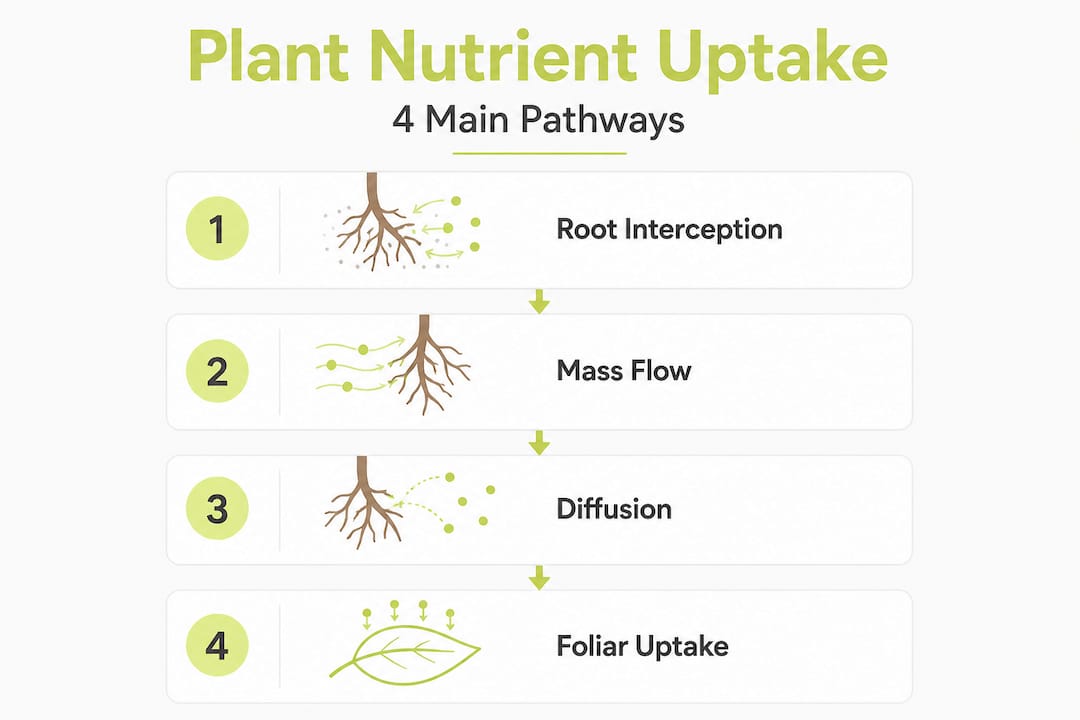
Now that you know why nutrient uptake matters, understanding how plants physically acquire these nutrients makes garden troubleshooting much easier. There are three primary mechanisms at work beneath the soil surface every time your plants are growing.
-
Root interception: As roots physically grow through the soil, they come into direct contact with nutrient particles. The root literally “runs into” nutrients and picks them up along the way. This pathway is most relevant for calcium and magnesium, and it depends heavily on active root growth. A plant with stunted or damaged roots simply intercepts less.
-
Diffusion: Nutrients move from areas of high concentration to areas of lower concentration, essentially sliding along a gradient toward the root surface. This process is slow and works best over short distances, making it most important for relatively immobile nutrients like phosphorus. Healthy soil structure and the right moisture level keep this pathway humming.
-
Mass flow: Water carries dissolved nutrients through the soil toward the roots as the plant transpires (releases moisture from its leaves). Nitrogen and calcium move primarily through this route. The faster a plant transpires and the more water moves through the system, the more nutrients arrive at the root surface via mass flow.
Once nutrients reach the root surface, entry into root cells can be either passive (moving with a concentration or electrical gradient, requiring no energy) or active (pumped in against a gradient, requiring cellular energy). This is part of why cellular energy production matters so much for nutrient efficiency.
| Pathway | How it works | Key nutrients | What affects it |
|---|---|---|---|
| Root interception | Root growth contacts nutrients | Calcium, magnesium | Root health, soil density |
| Diffusion | Concentration gradient movement | Phosphorus, zinc | Soil moisture, distance |
| Mass flow | Water carries dissolved nutrients | Nitrogen, calcium | Watering consistency, transpiration |
Pro Tip: Consistent, even soil moisture is one of the simplest ways to support mass flow uptake. Letting soil dry out completely between waterings slows water movement through the soil and reduces how much nitrogen and other mobile nutrients reach your roots.
What affects nutrient uptake efficiency?
Knowing the routes nutrients take is only part of the story. The next step is understanding what can help or hinder that journey in your specific garden. Several environmental and biological factors have a major influence, and many of them are fully within your control.
The biggest levers are:
- Soil moisture: Without adequate water, mass flow slows dramatically and nutrient uptake stalls. Dry soil also disrupts diffusion gradients, making phosphorus and other slow-moving nutrients even harder for roots to access.
- Soil pH: This is arguably the most underappreciated factor in home gardens. pH affects how soluble and available nutrients are in the soil. At very acidic or very alkaline levels, nutrients become chemically “locked up” even when they’re physically present in adequate amounts.
- Root health: Stressed, compacted, or damaged roots simply can’t do their job. Roots in healthy, aerated soil grow more actively, intercept more nutrients, and support better active transport.
- Organic matter: It improves soil structure, moisture retention, and microbial activity, all of which support stronger nutrient availability.
- Soil microbiology: Beneficial microbes and fungi (mycorrhizae) extend the effective reach of roots and help break down organic material into plant-usable forms.
Key stat: Most nutrients are most available to plants when soil pH sits between 6.0 and 7.0. Outside this range, nutrients like iron, manganese, and phosphorus can become largely unavailable even in well-fertilized soil.
Common mistakes that hurt nutrient uptake include over-fertilizing (which can create salt buildup, damaging root cells), ignoring pH entirely, watering inconsistently, and planting in compacted or poorly draining soil. Any one of these can create symptoms that look like a nutrient deficiency when the real issue is absorption efficiency, not nutrient supply.
Pro Tip: Before you add more fertilizer, test your soil pH and check your watering habits. A simple pH test from a garden center can reveal whether your nutrients are locked up rather than truly absent. Observing your plants’ symptoms alongside these checks gives you a much smarter starting point.
Beyond roots: Can leaves absorb nutrients?
The underground journey isn’t the whole story. Let’s look above ground at what role leaves can play in feeding your plants.
Leaves can absorb nutrients through a process called foliar uptake. The leaf surface, particularly through tiny pores called stomata and the waxy cuticle layer, allows certain dissolved nutrients to pass into plant tissue when applied as a liquid spray. This method is sometimes used by gardeners to quickly address deficiencies or give plants a short-term boost.
Research has even found that leaves absorb nitrogen and phosphorus from dust particles in arid environments like the Mojave Desert, suggesting that aerial nutrient acquisition is more significant than many gardeners realize, though it remains a secondary route compared to root uptake in most garden settings.
| Feature | Root uptake | Foliar uptake |
|---|---|---|
| Efficiency | High, primary route | Lower, supplemental |
| Speed | Moderate | Fast for targeted delivery |
| Nutrients | All macros and micros | Best for micros (iron, zinc, manganese) |
| When relevant | Always | Deficiencies, transplant stress, quick correction |
| Risk | Low with good soil practices | Leaf burn if overconcentrated |
For home gardeners, foliar feeding is most useful when:
- A plant shows signs of a specific micronutrient deficiency (like iron chlorosis, where leaves yellow between the veins)
- You need a rapid response during transplant stress or early recovery
- Soil conditions are temporarily preventing normal root uptake
Best practices for foliar feeding include:
- Dilute thoroughly: Foliar sprays should always be weaker than root drenches to avoid burning leaf tissue
- Apply in the morning: This gives leaves time to absorb before the sun intensifies and reduces the risk of fungal issues
- Use fine mist sprayers: Even coverage matters for effective absorption
- Don’t replace root care: Foliar feeding is a complement, not a substitute for good soil and watering practices
Biostimulants: Can they boost nutrient uptake for home gardeners?
If you want to push your garden further, you may have come across biostimulants on plant care shelves or in online communities. These are products that aim to work with your plant’s own biology rather than simply pushing more nutrients into the soil.
Plant biostimulants improve nutrient use efficiency by targeting the biological and physiological processes behind uptake itself, including effects on root growth, nutrient transport pathways, and the soil microbiome around the root zone (called the rhizosphere). Instead of just adding to what’s in the soil, they focus on helping plants absorb and utilize what’s already there more effectively.
Research findings are genuinely promising, though they’re also variable. Biostimulants that include mycorrhizal inoculants, humic acids, seaweed extracts, or amino acid compounds have shown real improvements in nutrient uptake efficiency in multiple studies. Results depend on the formulation, the dosing, and the specific plant and soil context.
Here’s a practical checklist for trialing biostimulants in your garden:
- Start with the basics first. Address pH, moisture, and root health before adding a biostimulant. These factors have a far greater impact and cost much less.
- Choose products with documented research. Look for biostimulants backed by university trials or peer-reviewed testing, not just testimonials.
- Apply consistently and as directed. Biostimulants aren’t a one-time fix. They work best when integrated into a regular care routine.
- Observe and track results. Note any changes in plant color, growth rate, and overall vitality over four to six weeks.
- Be patient and pragmatic. Set realistic expectations. Biostimulants are a supportive tool in a smart gardening system, not a standalone solution.
Pro Tip: If you’re new to biostimulants, try applying on one or two plants first before treating your whole garden. This gives you a personal reference point and helps you evaluate whether the product is delivering real, visible results in your specific conditions.
What most gardeners miss about nutrient uptake
Here’s an uncomfortable truth most plant care guides won’t tell you: the vast majority of struggling gardens aren’t suffering from a lack of nutrients. They’re suffering from conditions that block absorption. Fertilizer bags fly off the shelves while soil pH testers and moisture meters collect dust. That’s the real nutrient gap in home gardening today.
We’ve seen it again and again. A dedicated gardener adds fertilizer every two weeks, waters faithfully, and still watches their plants underperform. When they finally test their soil, the pH is sitting at 5.4, and half their nutrients have been chemically locked out the entire time. More fertilizer in that situation doesn’t help. It can actually make things worse by increasing salt stress on already-struggling roots.
The holistic approach, combining appropriate watering, a tested and corrected pH level, healthy root conditions, and thoughtful use of supplements when warranted, consistently outperforms the “add more and hope” method. Plants are living systems with their own internal logic. Respecting that logic, rather than overriding it with volume, is where real gardening skill lives.
Biostimulants and nutrient supplements absolutely have a place in a well-rounded gardening practice. But they work best when the foundations are solid. Think of them as the final layer in a well-built system, not the shortcut to skipping the layers beneath. And the most meaningful gardening breakthroughs tend to come not from a new product, but from a season of careful observation and honest adjustments.
Your garden is your own ecosystem, and no two are quite the same. Trust the evidence you see in your plants, test before assuming, and treat every season as an opportunity to learn what your specific plants and soil are telling you.
Ready to help your plants thrive?
Now that you understand how nutrient uptake works and what shapes it, you’re already a better gardener than most. The next step is finding the right tools to support your plants from the inside out. If you want to explore how cellular-level support can help your plants absorb more of what’s already in your soil, mitogrow's nutrient solutions offer a science-backed, pet-safe biostimulant approach designed for home gardeners and professionals alike. Whether your leafy friends are recovering from transplant shock, struggling through summer heat, or simply not living up to their potential, there’s a formula designed for exactly where they are right now. Because it’s not dead yet, and neither is your green thumb.
Frequently asked questions
What are the main nutrients plants absorb from soil?
Plants primarily absorb nitrogen, phosphorus, potassium, calcium, magnesium, and trace minerals like iron and zinc from the soil, each reaching roots through specific uptake pathways including root interception, diffusion, and mass flow.
How can I tell if my plants have poor nutrient uptake?
Yellowing leaves, stunted growth, or weak flowering can all signal uptake problems, especially when fertilizer use is already consistent. The most common underlying causes are soil pH imbalances or inconsistent moisture rather than a true nutrient shortage.
Can I increase nutrient uptake without more fertilizer?
Absolutely. Improving soil pH to the 6.0 to 7.0 range, maintaining consistent moisture, and supporting root health are highly effective ways to boost uptake. You can learn more about these gardening essentials and how they work together to support plant nutrition.
Are biostimulants safe for organic gardens?
Most biostimulants are naturally derived and compatible with organic gardening practices, though certification and effectiveness vary by product. Always check the label and look for research-backed formulations to ensure they align with your garden’s specific needs and certification requirements.


