


Why soil nutrients alone don't guarantee healthy plants
You’ve fed your plants, amended the soil, and followed every fertilizer label to the letter. Yet something still looks off. Yellowing leaves, stunted growth, wilting despite moist soil — these are the signs that trip up even experienced gardeners. The truth is, nutrient abundance in your soil and nutrient availability to your plants are two completely different things. Understanding that gap is what separates gardeners who keep guessing from those who actually fix the problem.
Table of Contents
- Why soil nutrients are not always enough
- The main barriers to nutrient uptake
- How pH and balance shape plant health
- What actually works: Advanced soil improvement strategies
- Next steps: Upgrading your soil health
- Frequently asked questions
Key Takeaways
| Point | Details |
|---|---|
| Nutrients aren’t always available | Soil nutrients can be present but unavailable due to pH, compaction, or antagonism. |
| Soil testing is essential | Annual soil and pH tests reveal imbalances and help target the true causes of poor growth. |
| Go beyond fertilizer | Adding compost, organic matter, or mulch boosts long-term health and reduces chemical dependence. |
| Balance matters | Wrong ratios or over-liming can create new problems even if basic nutrients seem sufficient. |
Why soil nutrients are not always enough
Most gardeners think of soil as a storage tank: fill it with nutrients, and plants drink up what they need. Reality is messier. Soil nutrient availability is tightly controlled by pH, moisture levels, temperature, and soil structure — and any one of those factors can lock nutrients away completely, even when they’re physically present in abundance.
This is where Liebig’s Law of the Minimum becomes essential knowledge. The most limited input constrains plant growth, regardless of how much of everything else you’ve added. If your soil is deficient in zinc but loaded with nitrogen, your plants will still struggle — and adding more nitrogen won’t help.
Nutrient antagonism adds another layer of complexity. When one nutrient is oversupplied, it can physically block the uptake of others at the root level. High calcium can suppress magnesium. Excess phosphorus can lock out zinc and iron. You can actually create new deficiencies by over-fertilizing.
“The law of the minimum reminds us that plant growth is not controlled by the total resources available, but by the scarcest one.” — Liebig’s Law of the Minimum
Common nutrient interactions that cause problems:
- High potassium reduces magnesium and calcium uptake
- Excess phosphorus blocks zinc and iron absorption
- Too much nitrogen can suppress boron availability
- High calcium from over-liming locks out manganese and iron
| Soil condition | Effect on nutrients | What you see in plants |
|---|---|---|
| pH below 5.5 | Aluminum and manganese become toxic | Leaf scorch, root damage |
| pH above 7.5 | Iron, zinc, manganese become unavailable | Yellowing between leaf veins |
| Excess potassium | Blocks magnesium and calcium | Leaf curl, blossom end rot |
| Excess phosphorus | Locks out zinc and iron | Stunted growth, pale leaves |
The main barriers to nutrient uptake
Knowing nutrients exist in your soil is one thing. Getting them into your plants is another challenge entirely. The barriers are physical, chemical, and biological — and most of them are invisible until your plants start showing symptoms.
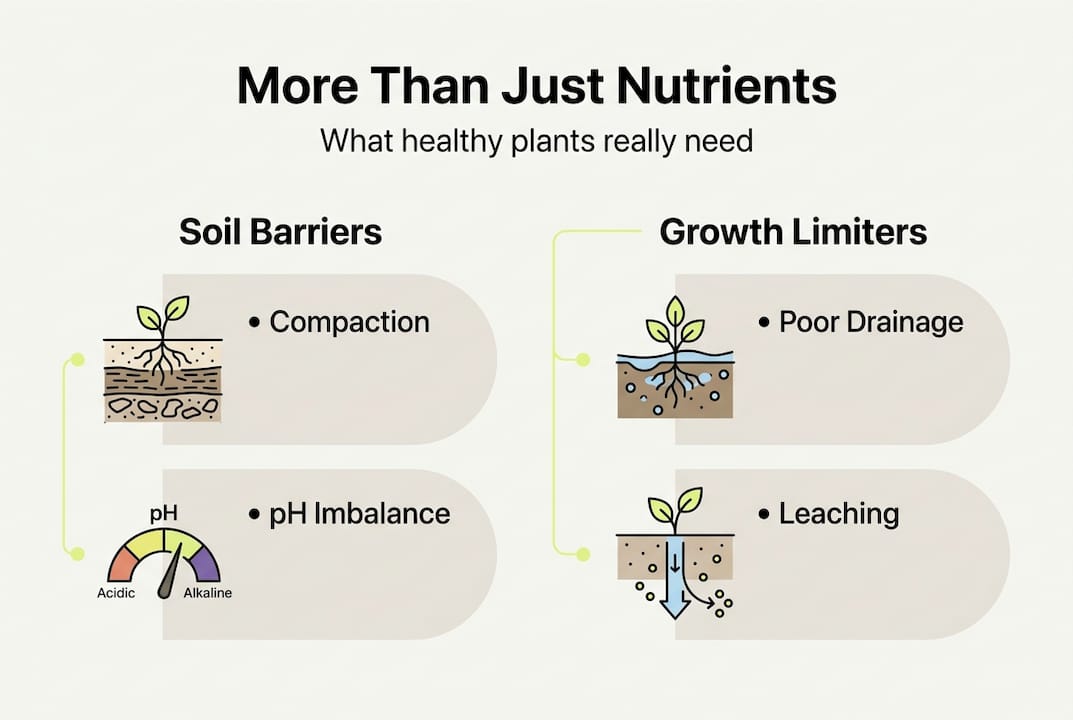
Soil compaction is one of the most underestimated problems in home gardens. Compacted soil reduces root growth, cuts off oxygen flow, and blocks water and nutrient infiltration. Roots need oxygen to drive the energy-intensive process of nutrient absorption. Without it, even a perfectly fertilized bed becomes a dead zone for uptake.

Leaching is the other silent thief. Mobile nutrients like nitrogen are easily washed below the root zone in sandy or low-organic-matter soils, especially after heavy rain or irrigation. Phosphorus and potassium can volatilize or bind to soil particles before roots ever reach them.
Container plants face this problem at an accelerated rate. Nutrients flush out with every watering, and the confined root zone means plants hit deficiency faster than anything growing in the ground.
Top reasons nutrients don’t reach your plants:
- Compacted soil blocking root expansion and oxygen flow
- Leaching from overwatering or sandy soil structure
- Nutrient antagonism from imbalanced fertilizer applications
- Low microbial activity reducing nutrient cycling
- Dry or waterlogged conditions shutting down root function
Pro Tip: Before adding more fertilizer to a struggling container plant, check the drainage. If water pools on the surface before soaking in, compaction or root binding is likely the real problem, not a nutrient shortage.
Statistic to know: Container plants can deplete their available nutrient supply in as little as 6 to 8 weeks, especially during active growth periods or in hot weather. Regular, smaller feedings outperform infrequent heavy doses every time.
How pH and balance shape plant health
If there’s one lever that controls more of your plant’s nutrition than any other, it’s soil pH. Think of pH as a dial that opens or closes the door to each nutrient. Turn it too far in either direction, and the door slams shut — regardless of what’s in the soil.
Optimal nutrient availability sits around pH 6.5 for most garden plants. At that sweet spot, the widest range of macro and micronutrients stays soluble and accessible. Push below 5.5 or above 7.5, and you start losing access to iron, manganese, zinc, and boron simultaneously.
The exceptions matter too. Blueberries, azaleas, and rhododendrons are acid-loving plants that thrive at pH 4.5 to 5.5. Trying to grow them in neutral or alkaline soil — even with perfect fertilization — will produce chronically deficient plants. But the opposite risk is real as well: over-liming soil to chase a higher pH can lock out micronutrients and damage plants that were doing fine before you intervened.
“Soil pH is the master variable in plant nutrition — it doesn’t just affect one nutrient, it affects all of them at once.”
Key pH facts every advanced gardener should know:
- Most vegetables and ornamentals prefer pH 6.0 to 7.0
- Acid-loving plants need pH 4.5 to 5.5 and will show deficiencies in neutral soil
- Lime raises pH; sulfur lowers it — both work slowly over weeks to months
- Organic matter buffers pH swings and keeps the range more stable over time
- Raised beds and containers drift toward acidic pH faster than in-ground soil
Pro Tip: Test your soil pH and nutrient levels at least once a year, ideally in early spring before planting season. A $15 soil test kit from your local extension office gives you data that no amount of visual guessing can replace.
What actually works: Advanced soil improvement strategies
Fertilizer is a tool, not a strategy. The gardeners who consistently grow healthy, resilient plants treat soil as a living system — and they manage it that way year-round, not just when something goes wrong.
Research confirms that integrating compost, mulch, organic matter, and microbial inoculants creates a soil environment where nutrients stay available, roots thrive, and plants resist stress. This isn’t just theory — it’s the foundation of every high-performing garden, from backyard beds to commercial nurseries.
The numbers back it up. Partial organic substitution — replacing a portion of synthetic fertilizer with organic inputs — increases soil quality by 31 to 335% and boosts yield by 5 to 6%, while cutting chemical fertilizer demand. That’s a significant return for a relatively simple shift in approach.
How to build a soil system that actually delivers nutrients:
- Add compost for garden beds at least once a year to feed soil microbes and improve structure
- Apply mulch options around plants to retain moisture, regulate temperature, and reduce compaction
- Use mycorrhizal inoculants at planting time to extend root reach and improve phosphorus uptake
- Rotate cover crops in vegetable beds to fix nitrogen and break compaction naturally
- Avoid tilling aggressively — no-till or minimal-till methods preserve fungal networks that move nutrients to roots
- Rebalance amendments based on annual soil test results, not guesswork
Pro Tip: The most common advanced gardener mistake isn’t under-fertilizing — it’s over-fertilizing while ignoring structure. A soil that drains well, holds moisture, and teems with microbial life will outperform a heavily fertilized, compacted bed every single time.
Organic matter is the single most impactful amendment you can add. It improves drainage in clay soils, increases water retention in sandy soils, feeds beneficial microbes, and buffers pH. Two to three inches of compost worked into the top six inches of soil each season builds the kind of foundation that makes fertilizer actually work.
Next steps: Upgrading your soil health
Once you understand that soil nutrients are only part of the equation, the next question is: what gives your plants the cellular capacity to actually use what’s available? That’s exactly where mitogrow comes in. mitogrow’s biostimulant formulas work at the cellular level, boosting nutrient uptake by up to 50% and activating your plant’s internal stress response — so the nutrients you’ve worked hard to provide actually reach their destination. Whether you’re managing a container garden, outdoor beds, or established trees and shrubs, mitogrow has a formula built for your specific setup. It’s pet-safe, impossible to overdose, and compatible with any fertilizer or amendment program you’re already running. If your plants are still struggling after doing everything right, this is the missing piece.
Frequently asked questions
How often should I test my soil for nutrients and pH?
Annual soil testing is the recommended baseline for advanced gardeners — test in early spring before planting to catch imbalances before they affect your season.
Will adding more fertilizer fix yellow leaves on my plants?
Not necessarily. Yellow leaves are often caused by pH imbalance, compaction, or nutrient antagonism rather than a simple shortage — adding more fertilizer can make the underlying problem worse.
What is nutrient antagonism in soil?
Nutrient antagonism occurs when an excess of one nutrient blocks plant uptake of another. High phosphorus blocks zinc and iron, while excess calcium from over-liming can lock out manganese and other micronutrients.
Why do container plants lose nutrients so fast?
Containers flush nutrients out with every watering, and plants deplete available nutrients in as little as 6 to 8 weeks during active growth — smaller, more frequent feedings are far more effective than occasional heavy doses.
Can organic matter really improve yield and reduce chemical use?
Yes. Partial organic substitution has been shown to boost yield by 5 to 6% while reducing chemical fertilizer demand by 8 to 10%, making it one of the highest-return strategies in advanced soil management.


