


Biostimulant for Reforestation and Restoration Projects: What Works at Scale
Reforestation and restoration projects rarely fail for one simple reason. Species, soil, water, weather, planting quality, and follow-up care all shape whether a seedling establishes. A biostimulant can be one part of that system, but the strongest programs use it to support a defined root-zone objective, then measure what happens in the field.
Explore mitogrow's plant science and root-health approach
In this guide, biostimulant reforestation means using a substance or microorganism to support natural plant processes during a restoration program. The practical question is not whether one input can solve every site problem. It is where a biostimulant fits, how to apply it responsibly, and which outcomes deserve measurement before a team expands the program.
What is a biostimulant for reforestation?
A plant biostimulant is a substance or microorganism applied to seeds, plants, the rhizosphere, soil, or another growing medium to support natural processes such as nutrient uptake, nutrient-use efficiency, and tolerance to abiotic stress. That definition, summarized in the USDA report on plant biostimulants, describes a function rather than a guaranteed result.
For a reforestation team, that distinction matters. A biostimulant is not a substitute for appropriate species selection, good nursery stock, correct planting depth, irrigation planning, erosion control, or a diagnosis of pests and disease. It is also not the same thing as a fertilizer. Fertilizer supplies plant nutrients. A biostimulant is intended to help natural plant or soil processes work more effectively, depending on the formulation, plant, and site.
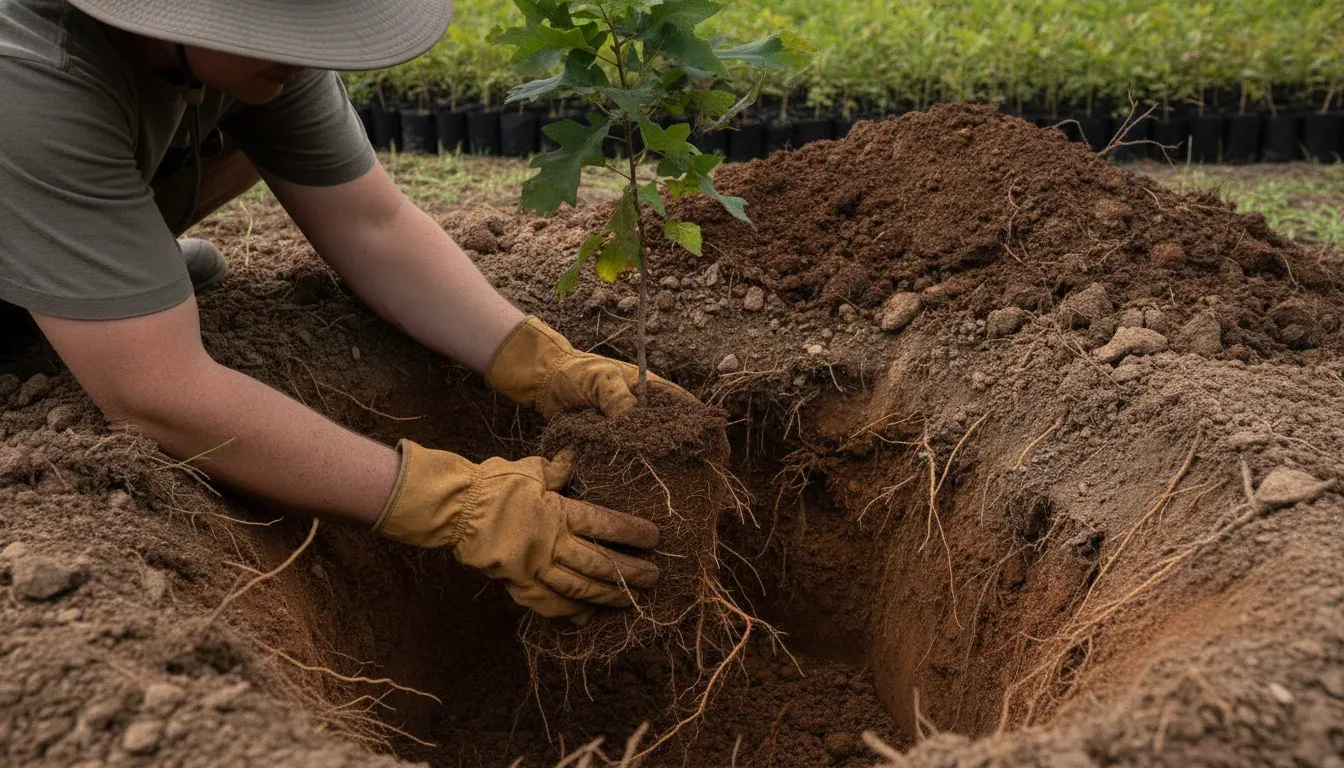
The relevant use case is usually establishment. A young tree or native plant must transition from nursery conditions to a variable field environment while rebuilding a functional root system. Supporting that transition may be valuable, but the treatment should be selected around the project's actual constraint rather than added as a blanket promise.
Why scale changes the biostimulant decision
A small garden trial and a multi-site restoration program do not have the same decision rules. At scale, a treatment must be repeatable, logistically manageable, label-compatible, and measurable across different crews and planting conditions.
| Program question | What to standardize | What must stay site-specific |
|---|---|---|
| Where will it be used? | Eligibility rules, treatment records, and crew training | Species, soil, slope, moisture, and disturbance history |
| What is the goal? | A written outcome such as establishment support or root-zone recovery | The likely limiting factor at each planting unit |
| How will it be applied? | Label review, mixing controls, equipment checks, and documentation | Timing and method allowed for the crop, tree, or site |
| How will success be judged? | Baseline fields, sampling points, and review dates | Expected response by species and local conditions |
This approach prevents a common scale mistake: treating a product name as a complete restoration strategy. A consistent process is useful. A universal biological outcome is not something a responsible team should assume. Teams that also manage commercial landscapes can compare this framework with mitogrow's commercial landscaping guide, which covers a different operating context.
Where a biostimulant can fit in a restoration workflow
The most defensible role is as a supporting step inside an existing planting and monitoring plan. A project manager can use the following sequence to decide whether a treatment belongs in the program.
1. Define the establishment problem
Start with the field condition, not the input. Is the project dealing with transplant stress, compacted soil, low moisture, poor nutrient availability, degraded microbial habitat, or inconsistent planting quality? These problems can overlap, but they do not have the same remedy. Record the baseline condition and identify which factor the treatment is intended to support.
2. Match the treatment to the planting material
Species and life stage matter. A native seed pellet, a container-grown tree, and a larger transplanted specimen have different handling and root-zone needs. Review the product label, application method, compatibility requirements, and local rules for the specific use. Do not transfer a nursery protocol to a restoration site without checking whether the conditions and directions match.
3. Protect the fundamentals first
Plant at the correct depth, manage competing vegetation, protect soil moisture, and address drainage or compaction where the project plan allows. A biostimulant cannot compensate for a root collar buried too deeply, a root ball that dries out, or a site that is not suited to the selected species.
4. Apply consistently and document the treatment
At scale, application consistency is part of the experiment. Record the product, lot or batch information when available, treatment date, crew, planting unit, weather, water source, and any deviations from the plan. Follow the current product label and project approval process. Avoid inventing a universal rate for every species or site.
5. Compare treated and untreated areas when feasible
A comparison does not need to be perfect to be useful, but it should be planned before the work begins. Matched planting units, repeated observations, and species-level records can help separate a treatment signal from rainfall, irrigation, soil depth, browsing, or planting-quality differences.
What restoration research says about microbial inputs
Research supports a careful, conditional view of biostimulants in restoration. A 2023 study in Microorganisms examined microbial amendments and whole-soil inoculums used with native plant seed pellets. The study found that outcomes depended on the plant species, amendment, and soil condition. Some treatments supported emergence or growth in particular settings, while the commercial vermicast amendment did not improve every outcome and reduced performance in some comparisons. For adjacent professional tree-care context, see the tree root stimulator field guide, which is not a substitute for restoration-specific evaluation.
That result is useful because it shows both the opportunity and the limit. Microbial or biological inputs may help in a site with a relevant soil constraint, but the response cannot be separated from the amendment, species, delivery method, and starting soil. Read the full native plant revegetation study before treating its findings as a field-wide recommendation.
Longer-term soil context matters as well. A U.S. Forest Service study of fungal communities associated with Appalachian reforestation reported that plant-associated soil fungal communities changed over three years and that different tree species showed differences in functional fungal groups. That does not prove that a commercial biostimulant caused better survival. It does reinforce why reforestation teams should consider the root zone as a living system and monitor more than above-ground color.
How to measure whether the program is working
Choose measures that reflect the project's objective. If the goal is establishment, count living plants and document condition over time. If the goal is root-zone recovery, define the observations that can reasonably indicate progress. If the goal is operational consistency, audit whether crews followed the protocol.
| Outcome | Useful measures | Interpretation guardrail |
|---|---|---|
| Initial establishment | Survival, vigor, new growth, and condition by species | Separate treatment effects from rainfall, irrigation, browsing, and planting quality |
| Root-zone support | Root inspection where appropriate, soil observations, and moisture records | Do not treat one observation as proof of long-term survival |
| Program execution | Application logs, crew checks, product records, and deviations | A weak protocol can make a useful input look ineffective |
| Restoration progress | Species composition, planted-tree survival, natural regeneration, and disturbance notes | Report project outcomes using the framework and timeframe selected for the site |
The Tree Restoration Monitoring Framework identifies planted-tree survival as a core indicator and notes that the first monitoring window may be six months to one year depending on local weather and project conditions. Use that as a planning reference, not a promise that every site will show the same response on the same schedule. For a contrasting, single-site example, the Lahaina banyan restoration case study shows why visible recovery signs still require ongoing monitoring.
Review results by species and planting unit whenever the sample allows. A project-wide average can hide a species that is failing, a slope that is drying out, or a crew that is applying the program differently. Restoration data becomes more useful when it helps the team change the next planting decision.
How mitogrow can fit an in-ground tree-care program
mitogrow's Tree & Shrub biostimulant is positioned for trees, shrubs, and woody plants in outdoor settings. The product page describes support for new plantings, nutrient uptake, and stress resilience. For a restoration or reforestation project, that makes it a potential component to evaluate within an approved root-zone and establishment program, not a replacement for site preparation or professional assessment.
The formula is positioned as plant fuel rather than fertilizer. The product page also says it can be used with fertilizer. That distinction is important for professional teams: whether the program includes fertilizer, compost, irrigation, mulch, or another soil practice, each input should have a defined purpose and follow its own label and project requirements.
For teams comparing options, begin with the mitogrow science page, review the current label and directions, and start with a controlled evaluation when the project allows. Keep claims modest until the project's own records show how the treatment performs under its species, soil, and climate conditions.
Review the mitogrow Tree & Shrub option for an in-ground planting program
Frequently Asked Questions
What does a biostimulant do in reforestation?
A biostimulant supports natural plant or soil processes that may influence nutrient uptake, nutrient-use efficiency, or tolerance to nonliving stress. In reforestation, it may be evaluated as one part of an establishment program. Its likely effect depends on the formulation, species, soil, delivery method, and site conditions, so it should not be presented as a guaranteed survival treatment.
Can a biostimulant replace fertilizer in a restoration project?
No. A biostimulant is not a direct replacement for fertilizer, and neither product category replaces sound planting, irrigation, or soil management. Fertilizer supplies nutrients. A biostimulant is intended to support natural processes that help a plant use available resources or handle stress. Use each product only for its approved purpose and follow the applicable label and project plan.
Should every planted tree receive the same biostimulant treatment?
Not automatically. Species, stock type, soil, moisture, season, and site history can change the appropriate approach. A scalable program can standardize its eligibility rules and records while keeping the actual treatment decision tied to the site. A small, documented evaluation is more informative than assuming one rate or method fits every planting unit.
How long should a reforestation team monitor results?
Use a monitoring schedule that fits the species, climate, and restoration objective. Early checks can identify planting or moisture problems, while later checks help evaluate establishment and species-level survival. The Tree Restoration Monitoring Framework describes a six-month to one-year window for initial planted-tree survival depending on local conditions. That is a planning reference, not a universal deadline or outcome.
What works at scale is a system, not a single input
Biostimulants may have a useful role in reforestation and restoration when the treatment answers a defined problem, fits the label and project plan, and is evaluated against a baseline. The repeatable advantage comes from disciplined planting, root-zone care, crew consistency, species-level monitoring, and honest interpretation of results.
For professional teams, the next step is not to promise that every tree will respond the same way. It is to define the establishment objective, choose a measured trial or approved program, and build the data needed for the next planting decision. That is how a biological input becomes part of restoration work that can scale responsibly.
Sources and further reading
- USDA report on plant biostimulants
- Characterizing Effects of Microbial Biostimulants and Whole-Soil Inoculums for Native Plant Revegetation
- U.S. Forest Service research on fungal communities and reforestation
- Tree Restoration Monitoring Framework
- Hawaii DLNR update on the Lahaina tree-cover restoration project


