How Plants Recover from Stress
Plant stress recovery is defined as the active biological process by which a plant restarts growth, repairs cellular damage, and restores physiological function once an environmental stressor is removed. This is not a passive bounce-back. Research published in 2026 confirms that plants use a “pause and push” mechanism, halting growth under stress and reactivating it through specific genes and biochemical pathways once conditions improve. Understanding how plants recover from stress gives you a real advantage as a caretaker, because the decisions you make in the first 24 to 72 hours after stress is removed can determine whether your leafy friend thrives again or declines past the point of no return.
What biological mechanisms enable plants to recover from stress?
Recovery begins at the genetic level. The gene CDKA;1 restarts cell division and growth once stress is removed, and plants without an active CDKA;1 gene fail to recover from cold and salt stress entirely. Think of this gene as the ignition switch for your plant’s growth engine. Without it firing, no amount of watering or feeding will get things moving again.
Alongside gene reactivation, the plant’s antioxidant defense system plays a critical role. Enzymes including superoxide dismutase (SOD), ascorbate peroxidase (APX), and catalase (CAT) form what researchers describe as a “redox-sensitive signaling platform” that maintains cellular balance during and after stress. These enzymes neutralize reactive oxygen species (ROS), which are the damaging byproducts that accumulate when a plant is under pressure. If ROS levels go unchecked, they break down cell membranes and proteins, making recovery much harder.
Stress memory is another fascinating piece of the puzzle. Plants can “remember” a previous stress event at the molecular level, which primes them for faster responses to future stressors. However, 97.9% of plants can recover from prolonged thermal stress by rapidly forgetting this stress memory and returning to a stable, high-yield physiological state. This means the plant’s flexibility, its ability to reset rather than stay locked in a stress response, is just as important as its ability to endure.
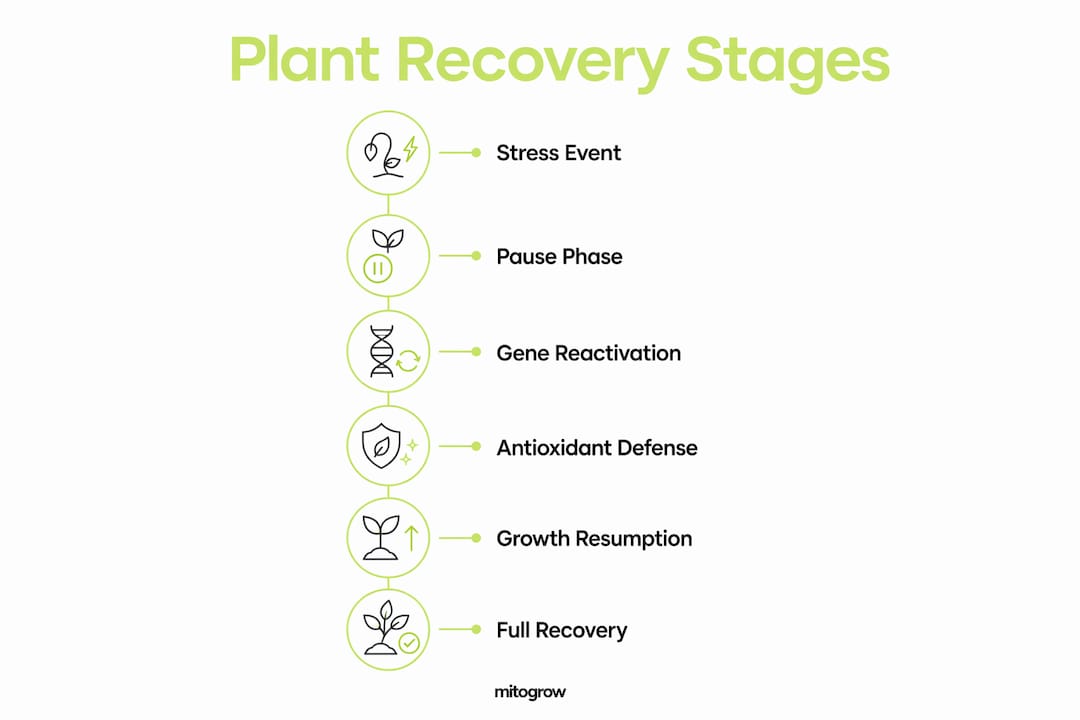
Here is what is happening inside your plant during recovery:
- Gene reactivation: CDKA;1 triggers cell division, restarting root and shoot growth
- Antioxidant surge: SOD, APX, and CAT neutralize ROS to protect cellular structures
- Stress memory fading: The plant releases its stress-primed state to return to normal metabolic function
- Hormonal recalibration: Abscisic acid (ABA) levels drop as the stress signal fades, allowing stomata to reopen and photosynthesis to resume
- Enzyme modification: Plants modify existing enzyme activity immediately after stress, which is why stable environmental conditions during recovery are so critical
Pro Tip: Do not mistake the “pause” phase for plant death. A plant that looks frozen in place after a stress event is likely recalibrating its cellular machinery. Give it 24 to 48 hours before drawing conclusions.
How does stress type affect recovery time?
Not all stress is created equal, and recovery timelines vary significantly depending on what your plant just went through. Cold and salt stress tend to allow root growth resumption within approximately 24 hours after the stressor is removed. That is relatively fast, and it reflects the fact that these stresses do not fundamentally disrupt the plant’s water status the way drought does.
Drought and osmotic stress are a different story. Water deficit affects turgor pressure throughout the plant, meaning cells cannot divide or expand properly until water balance is restored. Recovery from drought follows the “pause and push” dynamic more dramatically, with a longer stabilization period before visible growth resumes. Heat stress recovery is linked to rapid physiological reorganization rather than simple endurance, with the plant rerouting energy toward repair processes before returning to normal function.
| Stress type | Typical recovery start | Key recovery driver | Gardener priority |
|---|---|---|---|
| Cold stress | Within ~24 hours | CDKA;1 gene reactivation | Remove cold source, stabilize temperature |
| Salt stress | Within ~24 hours | Ion rebalancing, root resumption | Flush soil gently, avoid added fertilizer |
| Heat stress | 24 to 48 hours | Rapid physiological reorganization | Shade, consistent moisture, no transplanting |
| Drought stress | 48 hours or longer | Water balance restoration, turgor recovery | Gradual rehydration, mulch to retain moisture |
| Submergence stress | Variable by species | Oxygen restoration to roots | Improve drainage, avoid compacting soil |
Species-specific differences also matter here. Research on hydraulic coordination in drought recovery shows that ten dry-hot valley species varied significantly in how their vascular systems coordinated water movement during recovery, meaning a cactus and a fern will not follow the same recovery script even under identical drought conditions. Knowing your plant’s native habitat gives you a useful baseline for setting realistic expectations.
What practical techniques help plants recover from stress?
The most common mistake gardeners make is treating recovery like a growth phase. It is not. The first 24 to 48 hours after stress removal is a stabilization window, and over-fertilizing during this phase increases the salt load in the soil and adds metabolic demand at exactly the wrong moment. Hold off on feeding until you see new growth emerging.
Silicon and methionine are two supplements with real science behind them. Applying silicon and methionine helped cowpea plants recover more efficiently after water deficit by enhancing biochemical pathways and growth regulation. Silicon strengthens cell walls and reduces water loss, while methionine supports protein synthesis during the repair phase. These are not miracle cures, but they give the plant’s recovery machinery better raw materials to work with.
Biostimulants represent an exciting frontier for plant stress recovery techniques. Compounds like melatonin, flavonoids, and abscisic acid (ABA) act as emerging stress regulators that actively support defense pathways, going well beyond what traditional fertilizers can offer. These compounds work with the plant’s own signaling systems rather than overriding them.
Here is a practical do’s and don’ts list for post-stress plant care:
Do:
- Stabilize light and temperature conditions immediately after stress removal
- Water gradually and consistently, avoiding both drought and waterlogging
- Apply mulch around the root zone to regulate soil temperature and retain moisture
- Use biostimulants formulated with stress regulators like ABA or flavonoids
- Observe for 24 to 48 hours before intervening further
Don’t:
- Add fertilizer in the first 24 to 48 hours after stress removal
- Transplant or repot a stressed plant until new growth is visible
- Expose the plant to sudden changes in light intensity during recovery
- Prune aggressively while the plant is still in the stabilization phase
- Assume wilting means death. It often means the plant is conserving resources
Pro Tip: Mulching is one of the most underrated plant stress recovery techniques. A 2 to 3 inch layer of organic mulch around the root zone buffers soil temperature swings and keeps moisture consistent, giving roots the stable environment they need to regenerate.
How can you monitor plant recovery and spot irreversible damage?
Knowing whether your plant is recovering or declining is the difference between timely intervention and a lost cause. Here is a numbered sequence for monitoring recovery progress:
- Check photosynthetic efficiency. The metric Fv/Fm measures how well a plant’s photosystem II is functioning. Fv/Fm recovery within 48 to 72 hours after stress removal is a reliable indicator of successful recovery. Plants that fail to restore photochemistry in this window often have irreversible damage. You do not need a lab instrument to approximate this: look for leaves returning to their normal color and orientation.
- Watch for new root tips. In transparent pots or when gently checking soil, new white root tips emerging within 24 to 48 hours after cold or salt stress removal signal that CDKA;1 has reactivated and cell division is underway.
- Observe leaf turgor. Leaves that were wilted during stress should begin to firm up as water balance is restored. If leaves remain limp and discolored after 48 hours of stable conditions, the damage may extend to the vascular system.
- Look for new bud or shoot emergence. This is the clearest sign that the plant has moved from the stabilization phase into active recovery. It typically appears 3 to 7 days after stress removal in most common garden plants.
- Assess root color and texture. Healthy recovering roots are white or cream-colored and firm. Brown, mushy roots indicate rot or irreversible damage, particularly after submergence or overwatering stress.
The 48 to 72 hour window is your most important monitoring period. If you see no signs of turgor recovery, no new root activity, and continued leaf drop after three days of stable conditions, it is time to consider more aggressive intervention or accept that the plant may not recover.
Key takeaways
Successful plant recovery depends on understanding the “pause and push” mechanism, protecting the stabilization window, and using targeted interventions like biostimulants and silicon rather than defaulting to fertilizer.
| Point | Details |
|---|---|
| Recovery is gene-driven | CDKA;1 must reactivate to restart cell division; without it, growth cannot resume. |
| Stress type sets the timeline | Cold and salt stress allow recovery within 24 hours; drought takes significantly longer. |
| Stabilization before stimulation | Avoid fertilizing in the first 24 to 48 hours; let the plant recalibrate first. |
| Monitor Fv/Fm and root tips | Photosynthetic recovery and new root growth within 48 to 72 hours signal a healthy trajectory. |
| Biostimulants outperform fertilizers | Compounds like melatonin, ABA, and flavonoids actively support recovery pathways at the cellular level. |
Give your stressed plants a head start with Mitogrow
When your plants need more than just time and patience, Mitogrow offers a scientifically formulated biostimulant that works at the cellular level to support exactly the recovery processes described in this article. Mitogrow activates a plant’s internal stress response, supports cellular energy production, and boosts nutrient uptake by up to 50%, giving stressed plants the biological support they need to move from the stabilization phase into active growth. It is pet-safe, compatible with any fertilizer, and impossible to overdose. Whether you are nursing a drought-stressed garden bed or reviving a plant that looks beyond saving, explore the full Mitogrow product range to find the right formula for your situation.
FAQ
Do plants fully recover from stress?
97.9% of plants can recover from prolonged thermal stress by rapidly releasing stress memory and returning to a stable, high-yield state. Full recovery depends on stress severity, species, and the quality of care provided during the stabilization window.
How long does it take for a plant to recover from stress?
Recovery from cold or salt stress can begin within approximately 24 hours after the stressor is removed. Drought recovery takes longer, often 48 hours or more, because water balance must be fully restored before cell division can restart.
What is the biggest mistake gardeners make during plant recovery?
Over-fertilizing in the first 24 to 48 hours after stress removal is the most common error. Adding fertilizer too early increases soil salt load and metabolic demand, which actively hinders the recovery process rather than helping it.
What are the best biostimulants for plant stress recovery?
Compounds like melatonin, flavonoids, and abscisic acid (ABA) are emerging as effective plant stress regulators that support defense pathways at the cellular level. Silicon and methionine treatments have also shown measurable improvements in recovery speed and efficiency after water deficit stress.
How do you know if a plant is recovering or dying?
Fv/Fm photosynthetic recovery within 48 to 72 hours of stress removal is a reliable indicator of successful recovery. Visible signs include leaves regaining turgor, new white root tips emerging, and new bud or shoot growth appearing within 3 to 7 days of stable conditions.