How to Establish Large Trees After Installation
More than half of newly planted large trees do not survive their first two years in the ground. This massive failure rate happens because digging up a tree cuts away over ninety-five percent of its feeder roots. Saving these large trees needs precise care that goes far beyond basic watering.
Schedule a consultation for your next large tree planting project
Knowing how to establish large trees after installation is the key to stopping transplant shock, saving your landscaping investment, and helping long-term tree health. Success needs digging a wide planting hole to fit the root system, keeping the soil damp but not wet, and avoiding deep mulch. Research from the University of Tennessee Extension shows that watering is the single most critical factor because transplanted trees need more water than nursery stock. Using a patented biostimulant like mitogrow helps the tree grow new feeder roots quickly to support the massive canopy. With a clear care plan and professional tree and plant care, landscaping crews can ensure high survival rates and great results.
But how do you keep these large trees alive when the odds are against them? To protect your planting projects and secure your ROI, you first need to understand what really goes wrong during establishment and how to correct it. The sections below walk you through the full protocol.
How to Establish Large Trees After Installation the Right Way
Installing big trees gives a site instant scale, but their survival rate is often low. Data from the South Carolina Forestry Commission shows that over 50 percent of newly planted trees do not survive beyond one or two years. Learning how to establish large trees after installation starts with knowing why they fail.
Severe Root Loss in Big Specimens
The main cause of failure is severe root loss during digging. When a tree is dug, over 95 percent of its absorbing roots are cut off. Balled and burlapped trees lose almost their entire root system. Experts at the University of Tennessee say that only 4 to 9 percent of the roots remain in the root ball.
Most of a tree's fine roots grow near the surface, mostly in the top four to ten inches of soil. They spread far beyond the branches. When a tree is dug up at the nursery, almost all of these crucial roots are severed and left behind. This makes it hard for the newly planted tree to take in water on its own.
The Physiology of Transplant Shock
Small trees adapt much faster because they have less canopy to support and a higher root-to-shoot ratio. A small tree can replace its lost roots in a few short seasons. Large specimens take years. During this long recovery, the tree is at high risk from pests, disease, and drought.
This massive loss of roots causes severe water stress, leading to transplant shock. Without fine roots, the tree cannot absorb enough water to replace what is lost from its leaves. Growth slows to a crawl. Leaves wilt, twigs die back, and the large canopy makes this water shortage far worse.
Restoring Root and Canopy Balance
To survive, the tree must balance its canopy and its root system. This struggle lasts for years. If you do not support root growth during this critical window, the tree will die. You can improve tree transplant success rates by focusing on the roots rather than the branches.
To help the tree survive, you must focus on the root zone. Standard fertilizers can actually harm a stressed tree by forcing canopy growth before the roots can support it. Instead, you need to use ways that boost root growth. Proper watering, correct planting depth, and non-fertilizer soil supplements are key to helping the tree grow a strong root base.
Soil Prep and Planting Depth for Large Caliper Trees
Placing a large tree in the ground needs more than just digging a hole. When nursery staff harvest balled and burlapped trees, they move only 4 to 9 percent of the original root system. Because of this extreme root loss, your soil prep must be perfect to help the tree survive.
Hole dimensions and root ball prep
To give roots space to grow, dig a planting hole that is 1.5 to 3 times the width of the tree root ball. Do not dig the hole too deep, because the soil under it will settle and cause the tree to sink. The depth of your hole should be slightly less than the height of the root ball itself. If you use container-grown stock, you must find and cut any circling roots before planting. Cutting these roots stops them from choking the trunk later and helps them grow out into the native soil.
The critical role of the trunk flare
Finding the trunk flare is key when you plan how to establish large trees after installation. The topmost root must be within 2 inches of the soil surface. You should place the tree so that the root ball sits 2 to 3 inches higher than the ground around it. Planting slightly high lets the tree settle without drowning the root system. Most of the new roots will grow in the top 12 inches of soil, where they get plenty of air and water. If the flare is buried too deep, these new roots will choke and die from a lack of air.
To learn more about keeping root balls healthy, check our guide on tree transplant success rates.
Common depth mistakes during installation
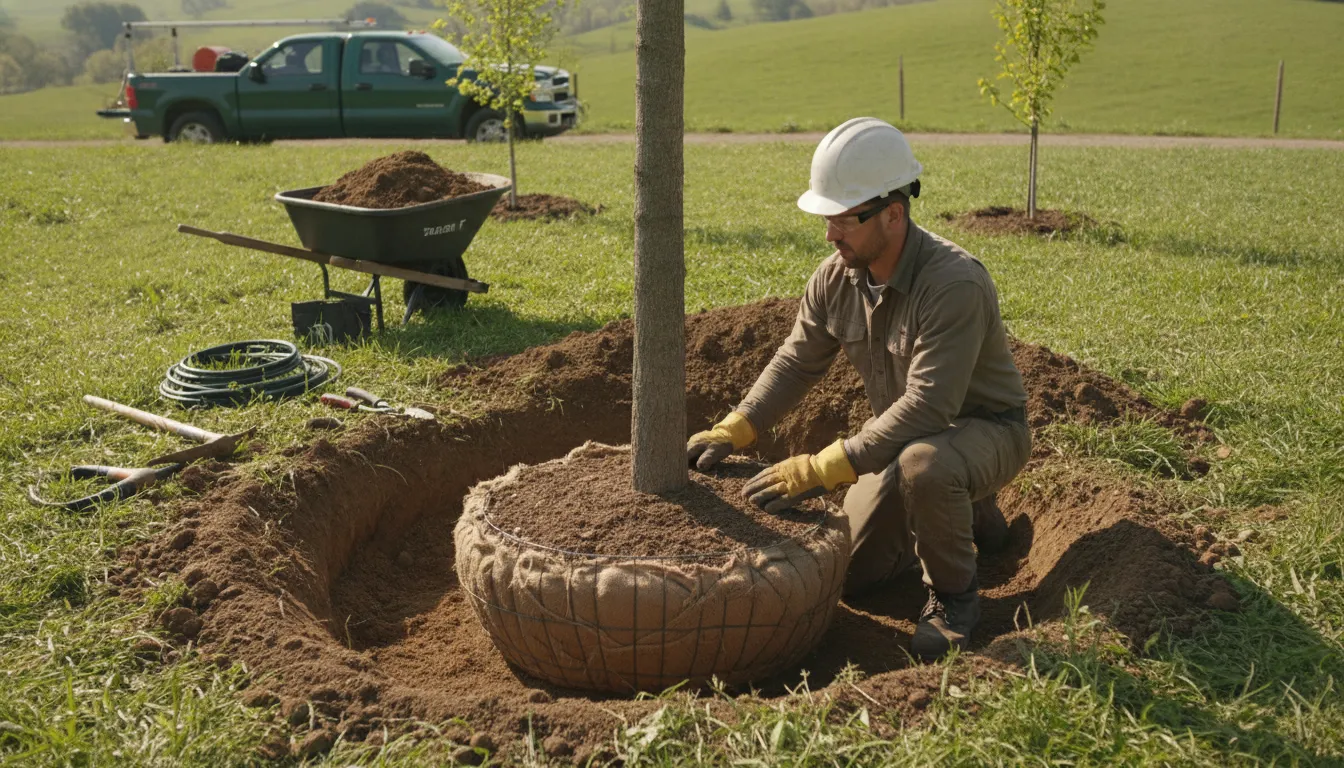
Many planters dig too deep and then backfill the bottom of the hole. Loose soil under the heavy root ball always compacts, which causes the tree to sink over time. Another common error is cutting large structural roots to make the ball fit a narrow hole. You must never cut large roots, as doing so can throw the tree into severe shock or kill it. Instead of cutting the roots, make the hole wider to fit them. Keeping the native soil loose around the sides of the hole helps new roots spread quickly.
When you backfill the hole, use the native soil that you dug out rather than adding heavy organic matter. Mixing too much rich compost into the hole can create a pocket that holds too much water and rots the roots. You want the roots to grow out into the nearby soil instead of staying inside a soft pocket. Gently pack the native soil around the root ball with your hands to remove large air gaps, but do not stomp on it. Stomping on wet soil compacts it and stops water from reaching the new root system.
The table below summarizes the most common large-tree planting decisions and the best practice for each.
| Planting Decision | Best Practice | Why It Matters |
|---|---|---|
| Hole width | 1.5 to 3 times the root-ball width. | Gives new roots loose soil to spread into. |
| Hole depth | Slightly less than root-ball height. | Prevents settling and burial of the trunk flare. |
| Trunk flare | Within 2 inches of the soil surface. | Keeps lower stem bark above ground. |
| Circling roots | Cut before planting. | Stops girdling and encourages outward growth. |
| Backfill | Native soil, gently packed. | Avoids soggy pockets and compacted clumps. |
Watering Protocols for Establishing Trees Over 2-Inch Caliper
The Critical Role of Water
Learning how to establish large trees after installation is the key to saving your landscape budget. When you move a large tree, most of its root system stays behind in the nursery. Because of this loss, water is the most critical factor to keep the tree alive. Without enough water, the newly planted tree will dry out and die.
Transplanted trees need more water than they did before. A small root system cannot absorb water from a large area of soil. To help the tree grow, you must keep the root ball wet. Good water care can help increase your tree transplant success rates.
How Often to Water Newly Planted Large Trees
How often should you water newly planted large trees? For the first two weeks after you plant, water the root ball every day. From week three to week twelve, water every two to three days. After twelve weeks, water once a week until the roots grow deep. This daily and weekly cycle ensures the soil stays damp but not soaked.
Frequent watering helps more than pouring a huge volume of water once a week. A big soak once a week does not help if the root zone dries out between waterings. If you let the roots dry out, the tree will suffer from stress. Steady watering keeps the soil damp so the new roots can grow.
Tailoring Soil and Species Needs
You cannot use a single watering plan for every tree. Other tree species and soil types have unique water needs. For example, clay soils hold water for a long time, while sandy soils drain fast. You must check the soil moisture in the root zone before you water. To do this, dig down a few inches near the trunk to feel if the soil is damp.
When watering a tree, you must apply enough to fully soak the soil in the root zone. A light sprinkle on the surface does not reach the deep roots. You want the water to reach the very bottom of the root ball. Running the water at a slow trickle helps it sink deep into the ground. This deep watering is the best way to prevent transplant shock.
To make sure your watering is on track, use these simple field checks:
- Test the soil depth by pushing a metal rod into the ground near the tree.
- Water early in the morning so the tree has enough moisture to handle the midday heat.
- Focus the water stream on the root ball rather than the lawn around the tree.
Weather changes will also change how often you water. During dry summer months, you may need to water more often to prevent drought stress. In contrast, you should scale back watering during rainy weeks to avoid soggy soil. Watching the weather keeps you from watering your large trees too much.
How Does Root Support Accelerate Establishment in Large Specimens?
The impact of root loss
When you move a large tree from a nursery, the plant goes through massive stress. In balled and burlapped (B&B) transplants, experts say that only 4 to 9 percent of the original root system is moved to the new site. The rest of the root mass is left behind in the nursery soil. This sudden loss makes it hard for the tree to take up water and food.
Large trees have a big canopy that needs constant water. Without a complete root system to support this top growth, the tree faces transplant shock. This shock can cause leaves to drop and branches to die back. To prevent this damage, the tree must grow new root tips as fast as they can to pull moisture from nearby soil.
How root stimulants act as plant fuel
To speed up this root growth, you can use a good biostimulant for arborists. The patented mitogrow Tree & Shrub formula has ingredients that drive root growth. It uses indole-3-butyric acid (IBA), which is a natural hormone that tells the plant to make new roots. It also has sea kelp and B vitamins like B1, B3, and B6. These ingredients do not feed the plant like a fertilizer would. Instead, they act as plant fuel to help the tree heal and grow.
The formula also has mycorrhizae fungi. These helpful fungi attach to the new roots. They stretch far into the soil to find water and food that the tree cannot reach on its own. This underground network grows the reach of the root zone. It helps the tree take root much faster and survive hot, dry weather.
Best practices for root care
Check the root ball for circling roots when you plant container-grown trees. According to expert guidelines, circling roots in container stock should be cut before planting. This pruning step tells the plant to grow new, healthy roots that spread out into the native soil. Left alone, these roots can strangle the tree as it grows.
Using a biostimulant helps the tree heal, but it does not replace basic tree care. You must still water the tree on a set schedule and plant it at the right depth. Think of root support as a boost to your normal care routine. It gives the tree the extra help it needs to fight transplant shock.
How Should You Monitor Large Trees in Their First 90 Days?
To learn how to establish large trees after installation, you must look past the day of planting. The first months are key to keep the tree alive. A tree suffers from water stress when its roots are cut during transplanting. Care during the first three years is needed to restore the balance between the root system and the canopy.
Establishing a Monitoring Timeline
A simple schedule helps you track the health of your new tree. You must watch the tree closely at set times to prevent loss. Regular checks allow you to spot signs of stress early. A tree that has lost most of its root system needs your help to recover. This plan outlines the steps you should take during the first three months.
- The 30-day checkpoint: Check soil moisture and look at the root ball for settling. Ensure that mulch depth is at most 3 inches as advised by the University of Tennessee Extension. High mulch can block air and water from reaching the roots. Inspect any stakes to make sure they do not scrape the bark or damage the trunk.
- The 60-day checkpoint: Look for a flush of new growth or green leaves on the branch tips. These signs show that the roots are starting to grow. Adjust watering based on your soil type and tree species to support this growth. Deep, thorough soaking is better than light watering.
- The 90-day checkpoint: Shift the tree to a normal care plan. Check the soil moisture deep in the root zone. Prepare the tree for weather stress like summer heat or winter cold. Proper prep now keeps the tree strong through the year.
How long does it take for newly planted trees to establish?
A large tree takes a long time to root. The rule of thumb is one year of care for every inch of trunk caliper. A three-inch caliper tree needs three years to establish. During this time, the tree is prone to transplant shock and stress. Data from the South Carolina Forestry Commission confirms that these trees need regular care to survive this period. Without proper care, more than half of these trees may die in the first two years.
Watering is the most vital part of this care. You must monitor soil moisture because each species and soil type has unique water needs. Proper watering is a major step to improve tree transplant success rates. Using a biostimulant like mitogrow can also help roots grow faster without the risk of fertilizer burn. This plant fuel strengthens the root system and helps the tree thrive.
Call (877) 365-8733 to plan root support for your large trees
Frequently Asked Questions
How long does it take for newly planted trees to establish?
Newly planted trees need about one year of establishment time for each inch of trunk caliper. During this key stage, they must balance their leaf canopy with their root system. According to the University of Tennessee Extension, root loss from transplanting severely limits how well a tree can support its top branches. Applying a biostimulant like mitogrow helps roots grow fast to shorten this time.
How often should you water newly planted large trees?
Newly planted trees need more frequent watering than they did in the nursery because of their small root systems. You should apply water directly to the root zone to soak the soil thoroughly. Research from the University of Tennessee Extension shows that frequent watering helps more than rare, heavy watering. Adjust your schedule based on your soil type and local weather.
What are the signs of transplant shock in large trees?
Trees with transplant shock often show wilted leaves, early fall color, or dying twigs at the top of the canopy. This happens because balled and burlapped trees lose most of their root system during harvest. The University of Tennessee Extension reports that only four to nine percent of the roots remain in the root ball. Using mitogrow helps the tree grow new roots to overcome this stress.
How deep should mulch be applied around new trees?
You should apply no more than three inches of mulch around newly planted trees. Spreading mulch too deep can block oxygen and water from reaching the root zone. A guide from the University of Tennessee Extension warns that deep mulch harms root health. Keep the mulch a few inches away from the tree trunk to prevent bark rot.
Are you ready to establish large trees after installation?
Large transplanted trees lose most of their active root systems during moving. This makes quick root care vital if you want them to survive. Waiting too long to feed the root zone leads to slow growth, high tree loss rates, and wasted commercial budgets. Starting a root fuel program today with mitogrow biostimulant ensures your new trees survive the harsh shock and take root fast. Our patented, scientific formula helps new roots grow quickly so your trees stand strong against harsh winds. For more details on commercial solutions, visit our contact page to send us a message online today.
Are you ready to get started? Call (877) 365-8733 today to schedule a consultation for your next large tree planting project.